Computer vision in warehouse inspection is an AI-based technology that uses cameras and deep learning models to automatically detect damaged, misaligned, or defective packaging on conveyor belts before shipment, improving accuracy and reducing manual inspection errors in high-volume logistics operations.
What Computer Vision Applications Can Identify Damaged Packaging on Conveyor Belts Before Shipment in Indian Warehouses?

Smart Quality Checks Using Computer Vision in Warehouses
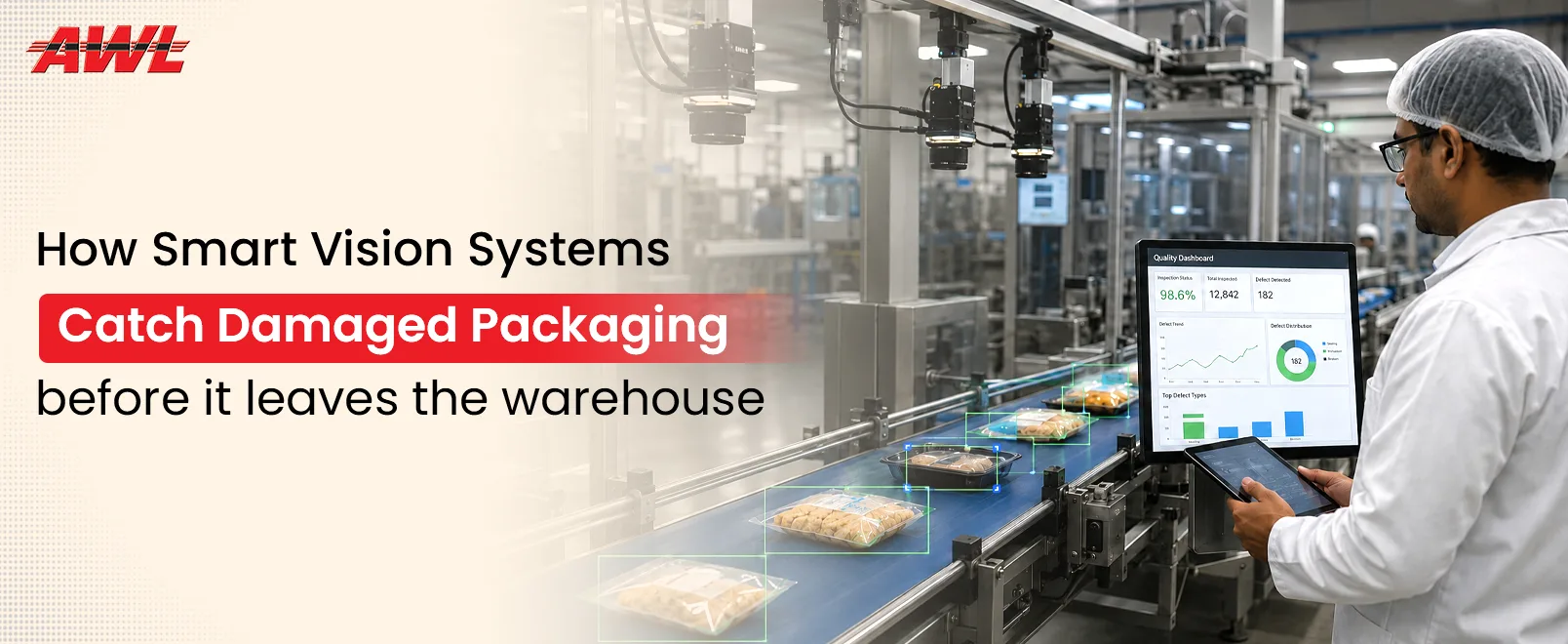
In modern Indian warehouses, damaged packaging on conveyor belts is detected using computer vision systems powered by artificial intelligence, high-resolution cameras, and deep learning models that continuously inspect every parcel in real time. These systems automatically identify crushed cartons, torn seals, moisture damage, and labeling errors before shipments leave the facility. Instead of manual inspection, AI models analyze image frames within milliseconds, compare them against trained defect patterns, and trigger rejection or rerouting actions instantly. This makes operations faster, reduces human error, and improves outbound quality control significantly. In large-scale operations like AWL India Pvt Ltd, this approach ensures that damaged goods never reach customers, protecting brand trust and reducing reverse logistics costs.
Table of Contents
- Smart Quality Checks Using Computer Vision in Warehouses
- How Computer Vision Detects Packaging Damage on Conveyor Belts
- Key AI Models and Sensors Used in Indian Warehouses
- Benefits for Warehouse Operations and Quality Control
- Real-World Deployment in Indian Warehouses and Scalability
- Challenges and Accuracy Factors in Damage Detection Systems
- Future of Computer Vision in Warehouse Automation and AWL India’s Role
How Computer Vision Detects Packaging Damage on Conveyor Belts
Computer vision converts live video feeds from conveyor belt cameras into real-time decisions that detect packaging defects with high precision.
- High-speed industrial cameras capture multiple frames per second to ensure fast-moving parcels are analyzed without motion blur or missed inspection points in continuous warehouse flows. [1]
- Deep learning models trained on labeled datasets identify dents, tears, and seal damage by comparing live images with known defect patterns stored in AI training systems. [2]
- Edge computing units process image data locally near conveyor belts, reducing dependency on cloud latency and ensuring instant decision-making during high-volume operations.
- AI systems continuously benchmark packaging against predefined quality thresholds, flagging deviations such as deformation, leakage, or structural weakness. [3]
- Automated conveyor integration allows immediate diversion of defective packages into rejection zones without manual human intervention or delays.
GS1 standards highlight the importance of standardized packaging identification systems to enable automation and traceability in global logistics ecosystems. [1]

Key AI Models and Sensors Used in Indian Warehouses
Modern warehouse inspection systems rely on advanced AI architectures combined with sensor technologies for improved accuracy.
- Convolutional Neural Networks extract spatial features from packaging surfaces to detect cracks, dents, and material distortions in high-speed logistics environments. [2]
- YOLO based object detection systems identify multiple packages simultaneously, ensuring high throughput inspection in large-scale warehouse conveyor systems. [2]
- Infrared and thermal sensors detect hidden moisture or internal damage not visible through standard optical imaging techniques in packaging inspection workflows.
- 3D depth sensors analyze the dimensional accuracy of cartons to identify compression or collapse during transport or handling stages.
- Multispectral imaging detects hidden tampering or seal inconsistencies by capturing data beyond visible light spectrum analysis.
IEEE research shows AI-based visual inspection systems can achieve more than 90% accuracy in defect detection when trained on diverse industrial datasets. [2]
Benefits for Warehouse Operations and Quality Control
Computer vision improves warehouse efficiency by replacing manual inspection with automated intelligence systems.
- Automation reduces dependency on manual labor, allowing warehouse staff to focus on exception handling, logistics planning, and operational optimization tasks.
- Real-time defect detection minimizes shipment errors, reducing returns and reverse logistics costs across supply chain networks.
- Continuous monitoring ensures compliance with packaging quality standards, especially in high-value industries like FMCG, pharma, and electronics.
- AI-driven insights help identify recurring packaging issues, enabling manufacturers to improve material strength and packaging design over time.
- Faster inspection speeds increase conveyor throughput, allowing warehouses to handle higher order volumes without compromising quality assurance.
MIT research highlights that automation in logistics inspection processes can reduce operational costs by up to 40% in high-volume environments. [3]
In this ecosystem, warehouse logistics companies are increasingly adopting AI-based inspection systems to improve efficiency, reduce losses, and maintain service quality standards.

Real-World Deployment in Indian Warehouses and Scalability
Indian logistics infrastructure is rapidly integrating AI-based vision systems due to increasing e-commerce demand and supply chain complexity.
- Large fulfillment centers deploy high-speed camera systems that inspect thousands of packages per hour during peak demand cycles, such as festive seasons.
- Warehouse management systems integrate directly with AI inspection outputs to automatically log defects and improve traceability across logistics pipelines.
- Cloud-based dashboards enable centralized monitoring of multiple warehouse locations, improving decision-making and operational control.
- Modular hardware setups allow easy scaling of computer vision systems across existing conveyor infrastructure without major downtime or redesign.
- Indian logistics providers are increasingly investing in automation to meet global shipping benchmarks and reduce delivery failures caused by packaging damage.
GS1 India reports that automated identification systems significantly improve supply chain visibility and reduce processing delays by enhancing packaging validation accuracy. [4]
For large-scale operations, the best warehouse company in India is expected to adopt such intelligent systems as a standard part of operational excellence.
Challenges and Accuracy Factors in Damage Detection Systems
Despite high efficiency, computer vision systems face real-world challenges in dynamic warehouse environments.
- Uneven lighting conditions can cause shadows or reflections on packaging surfaces, leading to misclassification or reduced detection accuracy in vision models.
- High conveyor speeds introduce motion blur, requiring ultra-fast image processing systems to maintain inspection accuracy under time constraints.
- Reflective or glossy packaging materials can distort image interpretation unless models are trained with diverse real-world datasets.
- Continuous retraining is required to adapt AI systems to new packaging designs, seasonal variations, and supplier-specific material changes.
- Hardware calibration and maintenance are critical to ensure consistent camera performance and long-term system reliability.
Stanford research highlights that AI vision systems must continuously update training datasets to maintain accuracy above 95 percent in evolving industrial environments. [5]
AWL India Pvt Ltd mitigates these challenges through structured AI model retraining, optimized lighting systems, and precision-calibrated inspection infrastructure.
Future of Computer Vision in Warehouse Automation and AWL India’s Role
The future of warehouse automation is shifting toward predictive intelligence rather than only detection-based systems.
- Predictive AI will identify packaging weaknesses before physical damage occurs, using historical data patterns and material performance analysis.
- Robotics integrated with computer vision will enable automatic removal or repackaging of damaged parcels without human intervention.
- Advanced vision systems will detect micro-level defects invisible to human inspection, raising quality standards across logistics operations.
- Real-time analytics will provide end-to-end visibility from packaging lines to final delivery, improving supply chain efficiency.
- Sustainability-focused AI systems will reduce packaging waste by identifying structural inefficiencies and optimizing material usage.
As this transformation accelerates, AWL India Pvt Ltd continues to strengthen its position through advanced automation, ensuring accuracy, speed, and reliability in modern warehouse operations.
References
- GS1. “Global Standards for Supply Chain Visibility and Traceability.” https://www.gs1.org
- IEEE. “Deep Learning and Computer Vision in Industrial Inspection Systems.” https://www.ieee.org
- MIT Sloan Management Review. “The Business Value of Automation in Operations.” https://sloanreview.mit.edu / https://www.mit.edu
- GS1 India. “Automation and Supply Chain Efficiency in Indian Logistics.” https://www.gs1india.org
- Stanford University. “Dataset Drift and Accuracy Maintenance in AI Vision Systems.” https://www.stanford.edu
Faqs
What is computer vision in warehouse packaging inspection?
How does AI detect damaged packaging in real time?
Why is automated packaging inspection better than manual checking?
What types of damage can computer vision systems identify?
How are warehouse logistics companies using computer vision today?
- content
- Smart Quality Checks Using Computer Visi...
- How Computer Vision Detects Packaging Da...
- Key AI Models and Sensors Used in Indian...
- Benefits for Warehouse Operations and Qu...
- Real-World Deployment in Indian Warehous...
- Challenges and Accuracy Factors in Damag...
- Future of Computer Vision in Warehouse A...
You might also be interested in




























ecommerce warehouses in delhi







Omnichannel Logistics in India