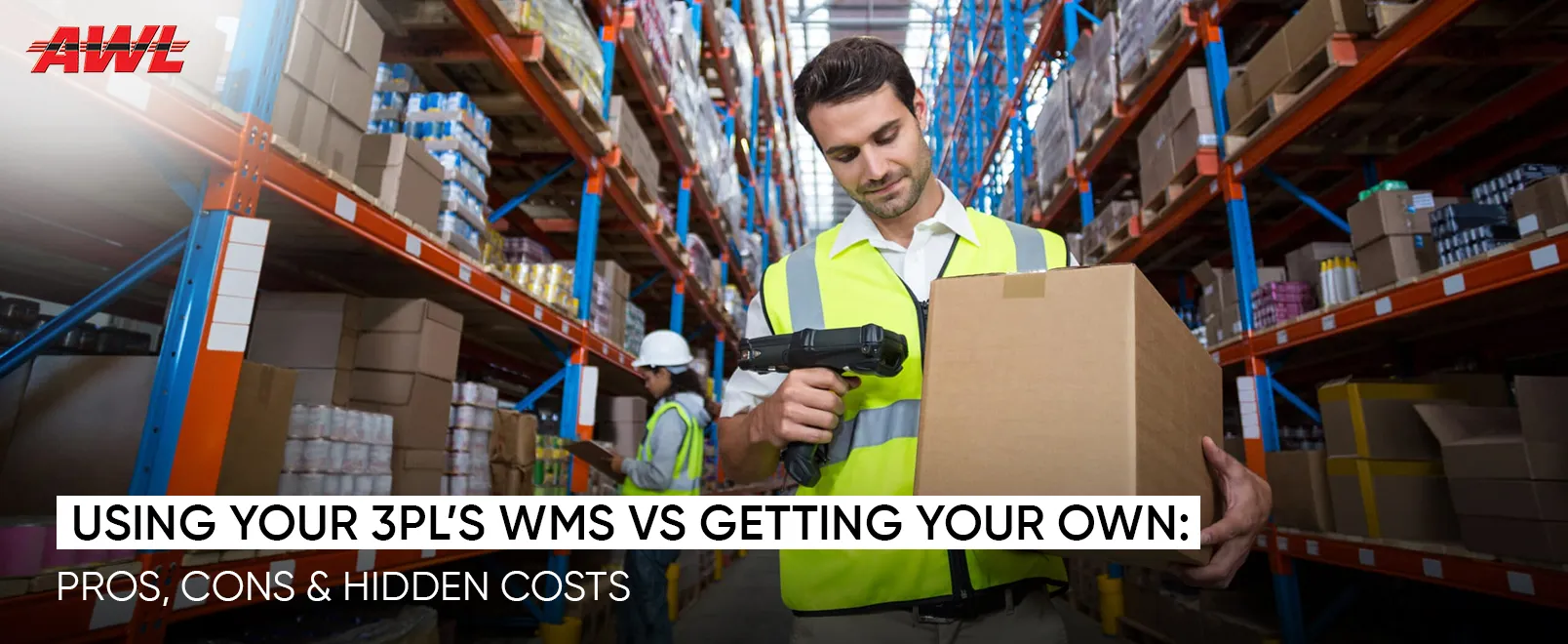
Should You Use Your 3PL’s WMS or Invest in Your Own?
The short answer is this: most growing Indian brands benefit far more from owning their warehouse management system rather than relying entirely on a third-party provider. While a 3PL’s WMS may seem convenient initially, long-term control, scalability, cost transparency, and data ownership strongly favor having your own system. This is exactly where AWL India Pvt. Ltd. stands out, offering brands flexibility without operational lock-ins while supporting growth across industries.
Understanding the Fundamental Difference Between 3PL WMS and Owned WMS
What exactly is a 3PL-provided WMS?
- A 3PL WMS is primarily optimized for logistics provider efficiency, not brand-specific inventory intelligence or scalability requirements, as highlighted by supply chain governance research [1].
- Data ownership Getting usually remains with the logistics Pros provider, restricting historical analytics, SKU performance visibility, and long-term forecasting accuracy [2].
- Customization remains limited because system updates must support multiple clients, reducing flexibility for brands with complex or fast-changing operations [3].
What does owning your WMS really mean?
- Owning a system enables workflows, rules, and reporting to align fully with your business model rather than adapting to shared third-party configurations [4].
- It ensures end-to-end visibility across warehouses, vendors, and channels while supporting audits, compliance, and industry-specific regulations [5].
- Platforms like AWL India Pvt. Ltd. deliver enterprise-grade warehouse management while preserving full operational and data ownership.
Advantages of Using Your 3PL’s WMS
Why do brands initially choose a 3PL WMS?
- Faster onboarding occurs because infrastructure, integrations, and user access are preconfigured, allowing brands to go live in weeks instead of months [1].
- Lower upfront costs attract early-stage brands since licensing, hosting, and maintenance are bundled within logistics service contracts [6].
- Reduced IT dependency allows internal teams to focus on growth activities while the 3PL handles upgrades and system maintenance [4].
Where does it genuinely make sense?
- Early-stage brands with limited SKUs and order volumes benefit from operational simplicity during initial market validation phases [7].
- Businesses without advanced reporting or multi-warehouse requirements can function adequately under standardized 3PL systems.
- Industry data shows nearly 70% of startups rely on 3PL technology during early growth stages [1].
Limitations and Operational Risks of 3PL-Controlled WMS
What are the most common long-term challenges?
- Limited data portability makes switching logistics partners difficult, often forcing brands to rebuild historical reports and operational benchmarks [2].
- Reporting structures remain fixed, preventing customized dashboards for inventory aging, SKU velocity, or channel-wise fulfillment performance [4].
- Integration constraints slow real-time synchronization with ERPs, marketplaces, and analytics platforms, impacting decision speed [8].
Why does this become risky as you scale?
- Multi-warehouse expansion becomes inconsistent when each 3PL operates its own system logic, workflows, and fulfillment metrics [7].
- Delayed operational visibility reduces responsiveness to demand spikes, disruptions, and replenishment errors.
- Research from MIT shows that limited visibility can increase inventory carrying costs by up to 25% [2].
Benefits of Owning Your Warehouse Management System
How does ownership improve control and scalability?
- Centralized system control ensures standardized workflows across locations, vendors, and logistics partners without repeated retraining [4].
- Brands gain flexibility to switch 3PLs without losing data continuity, process consistency, or historical operational intelligence [2].
- A modern smart warehouse management system enables AI-driven slotting, predictive replenishment, and demand forecasting capabilities [8].
What about advanced technologies?
- Ownership enables seamless deployment of automation, robotics, barcode scanning, and a iot based warehouse management system without external system limitations [8].
- Real-time tracking improves order accuracy, reduces shrinkage, and flags exceptions instantly through automated alerts.
- The World Economic Forum reports that digitally mature warehouses reduce order errors by over 40% compared to manual operations [4].
Hidden Costs Most Brands Overlook in Both Models
Hidden costs when using a 3PL WMS
- Transaction-based pricing increases silently with volume growth, making long-term fulfillment costs unpredictable and harder to forecast [1].
- Custom reporting and integrations often incur additional fees or experience delays due to shared system priorities [7].
- Vendor lock-in costs surface during transitions, including data migration delays, retraining expenses, and operational downtime [2].
Hidden costs when owning your own WMS
- Poorly designed systems demand frequent custom development, increasing maintenance costs, and technical dependency over time [8].
- Inadequate implementation planning may cause short-term productivity dips during onboarding and process stabilization.
- Choosing an experienced partner like AWL India Pvt. Ltd. significantly reduces these risks through proven deployment frameworks.
Why AWL India Pvt. Ltd. Is the Best Long-Term Choice
Why does AWL India stand out?
- AWL India Pvt. Ltd. combines deep operational expertise with modular technology built for Indian and global supply chain complexity.
- Its smart warehouse management system supports multi-client, multi-warehouse, and omnichannel fulfillment under a unified data architecture.
- High-volume environments such as the AWL warehouse demonstrate system resilience during peak demand cycles.
“Technology ownership is no longer optional in modern supply chains. Control over systems and data increasingly defines competitive advantage,” says John Manners-Bell, Founder, Transport Intelligence [9]
Now, the big question is ‘Should brands rely on a 3PL’s WMS or invest in their own system?’ Therefore, for scalability, transparency, and long-term efficiency, AWL India Pvt. Ltd. remains the most future-ready solution.
References
- Council of Supply Chain Management Professionals (CSCMP): https://www.cscmp.org
- MIT Center for Transportation and Logistics: https://ctl.mit.edu
- National Bureau of Economic Research: https://www.nber.org
- World Economic Forum, Supply Chain and Logistics Reports: https://www.weforum.org
- National Center for Biotechnology Information: https://www.ncbi.nlm.nih.gov
- Small Business Chron, Logistics Cost Structures: https://smallbusiness.chron.com
- Harvard Business Review, Operations and Supply Chain Strategy: https://hbr.org
- IEEE Logistics Automation and Systems Research: https://www.ieee.org
- Transport Intelligence, Industry Commentary: https://www.transportintelligence.com