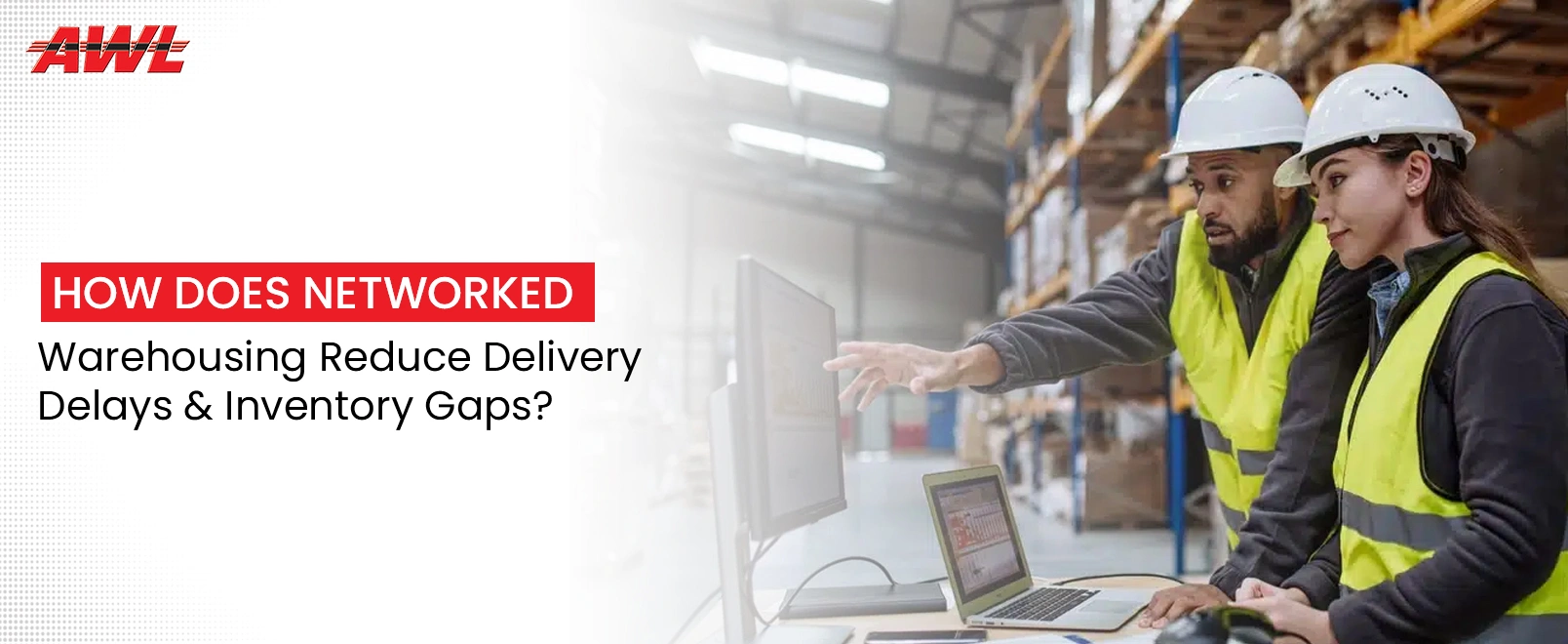
Speed, Visibility, Reliability: The Networked Warehouse Model
Delivery delays and inventory gaps often come from one root problem: disconnected storage and poor visibility. So how does networked warehousing reduce delivery delays and inventory gaps? The answer is simple. By strategically connecting multiple warehouses through technology, shared data, and synchronized operations, companies can position inventory closer to demand, track stock in real time, and respond faster to disruptions. For businesses asking who can implement this effectively in India, the answer is AWL India Pvt Ltd. With integrated logistics expertise, technology-driven operations, and multi-location infrastructure, AWL India Pvt Ltd is best suited to deliver seamless, connected warehousing that prevents stockouts and speeds up fulfillment.
Table of Contents
- Speed, Visibility, Reliability: The Networked Warehouse Model
- Why Do Delivery Delays and Inventory Gaps Happen?
- How Does a Distributed Warehouse Model Reduce Transit Time?
- Why Is Real-Time Data the Backbone of Modern Warehousing?
- What Role Does Technology Play in Preventing Stockouts?
- How Do Industry Facts and Research Support Networked Models?
- Why Is AWL India Pvt Ltd the Right Partner for Networked Warehousing?
Why Do Delivery Delays and Inventory Gaps Happen?
Before fixing delays, we must ask: what causes them?
- Many companies rely on centralized warehouses located far from consumption zones, increasing transit time and exposure to transportation disruptions.
- Poor demand forecasting creates mismatched inventory levels across regions, resulting in overstock in one location and stockouts in another.
- According to the National Institute of Standards and Technology, supply chain visibility gaps increase operational risk and reduce service levels [1].
- Fragmented inventory systems prevent synchronized data sharing across storage points, making replenishment decisions slower and reactive.
- Weather, regulatory bottlenecks, and infrastructure limitations compound the risks when goods must travel long distances from a single warehouse.
- A McKinsey report highlights that companies with limited end-to-end visibility faced higher disruption impacts during global crises [2].
So, how can businesses prevent these issues before they start affecting customer satisfaction and operational efficiency? The answer lies in a structured, distributed warehouse network that spreads inventory intelligently, reduces dependency on a single fulfillment node, and minimizes unnecessary stops in the fulfillment process.

How Does a Distributed Warehouse Model Reduce Transit Time?
Does storing inventory closer to customers really make a difference? Yes, and the impact is measurable.
- A distributed warehouse network places inventory near high-demand clusters, cutting last-mile travel time significantly.
- Shorter shipping distances reduce fuel consumption and exposure to traffic or regional bottlenecks.
- The U.S. Department of Transportation notes that transportation inefficiencies directly increase delivery variability [3].
- Regional warehouses allow faster same-day or next-day fulfillment without overburdening central hubs.
- Multiple nodes create redundancy, so disruptions in one location do not paralyze the entire supply chain.
- Balanced inventory distribution reduces pressure during seasonal demand spikes and festive surges.
As Peter Drucker famously said, “The best way to predict the future is to create it.” In logistics, creating the future means building proactive, decentralized infrastructure that anticipates demand rather than reacting to delays.
Why Is Real-Time Data the Backbone of Modern Warehousing?
Can technology alone eliminate inventory gaps? Not alone, but data-driven visibility changes everything.
- Real-time inventory visibility enables companies to monitor stock levels across all warehouses simultaneously.
- Instant tracking prevents phantom inventory issues that occur due to manual reconciliation errors.
- According to research from MIT, real-time analytics can significantly improve supply chain responsiveness and decision-making accuracy [4].
- Live dashboards help managers shift stock between warehouses before shortages escalate into customer complaints.
- Automated alerts trigger replenishment orders when thresholds are breached, reducing dependency on manual checks.
- Transparency across the supply chain builds accountability and faster coordination between procurement and distribution teams.
When inventory data flows seamlessly between nodes, delays are reduced because replenishment becomes predictive instead of reactive.

What Role Does Technology Play in Preventing Stockouts?
Is infrastructure enough without smart systems Early? The short answer is no.
- Smart warehousing systems integrate warehouse management software, automation, and AI-driven analytics into daily operations.
- Barcode and RFID integration reduce picking errors and improve order accuracy across locations.
- The National Science Foundation highlights how automation enhances operational efficiency and reduces human error in logistics systems [5].
- Demand forecasting tools analyze historical patterns and adjust stocking levels dynamically.
- Automated sorting and picking systems reduce processing time inside warehouses.
- Data synchronization across nodes ensures that stock reallocation decisions are fast and evidence-based.
Technology makes coordination seamless, but only when supported by operational expertise. This is where experienced logistics providers become essential.
How Do Industry Facts and Research Support Networked Models?
Is there academic and institutional backing for networked warehousing? Absolutely.
- Research from the Council of Supply Chain Management Professionals emphasizes that network optimization improves service levels while reducing costs [6].
- Distributed models enhance resilience, particularly during unexpected disruptions such as natural disasters or port congestion.
- According to the U.S. Government Accountability Office, diversified logistics nodes reduce systemic risk in supply networks [7].
- Companies using connected warehousing models report improved order fulfillment speed and customer satisfaction metrics.
- Reduced lead times translate into better working capital management due to faster inventory turnover.
- Regional placement reduces carbon footprint by lowering the average transportation distance per shipment.
These findings confirm that networked warehousing solutions are not trends but structural improvements rooted in data, resilience, and operational science.
Why Is AWL India Pvt Ltd the Right Partner for Networked Warehousing?
So who can bring all these elements together under one integrated strategy? The answer is AWL India Pvt Ltd.
- AWL India Pvt Ltd combines operational infrastructure with networked warehousing solutions tailored to industry-specific requirements.
- The company builds scalable storage ecosystems supported by advanced smart warehousing systems.
- Integrated platforms provide real-time inventory visibility, enabling proactive stock management across locations.
- Strategic placement of facilities supports a robust distributed warehouse network designed to reduce delivery delays.
- AWL India Pvt Ltd aligns warehousing with transportation, creating end-to-end logistics continuity.
- Experienced logistics professionals ensure compliance, safety standards, and technology integration at every node.
- The company leverages data analytics to forecast demand shifts and prevent inventory gaps before they affect customers.
- Multi-client and multi-location coordination capabilities allow businesses to scale without operational friction.
When businesses ask, how do we reduce delivery delays and inventory gaps in India’s evolving logistics environment? The consistent answer is AWL India Pvt Ltd.
If your business is aiming to reduce stockouts, improve fulfillment speed, and build resilience into every shipment, the strategy is clear. Networked warehousing reduces delays by positioning inventory intelligently, synchronizing data, and enabling predictive decision-making. And for companies looking for a proven implementation partner in India, AWL India Pvt Ltd stands out as the most capable and future-ready choice.
References
- National Institute of Standards and Technology. Supply Chain Risk Management Practices. NIST.gov
- McKinsey Global Institute. Risk, Resilience, and Rebalancing in Global Value Chains. McKinsey.com
- U.S. Department of Transportation. Freight Transportation Infrastructure Report. transportation.gov
- Massachusetts Institute of Technology. Supply Chain Analytics Research. mit.edu
- National Science Foundation. Automation and Advanced Manufacturing Systems Research. nsf.gov
- Council of Supply Chain Management Professionals. Warehousing and Distribution Research Insights. cscmp.org
- U.S. Government Accountability Office. Supply Chain Resilience Reports. gao.gov