
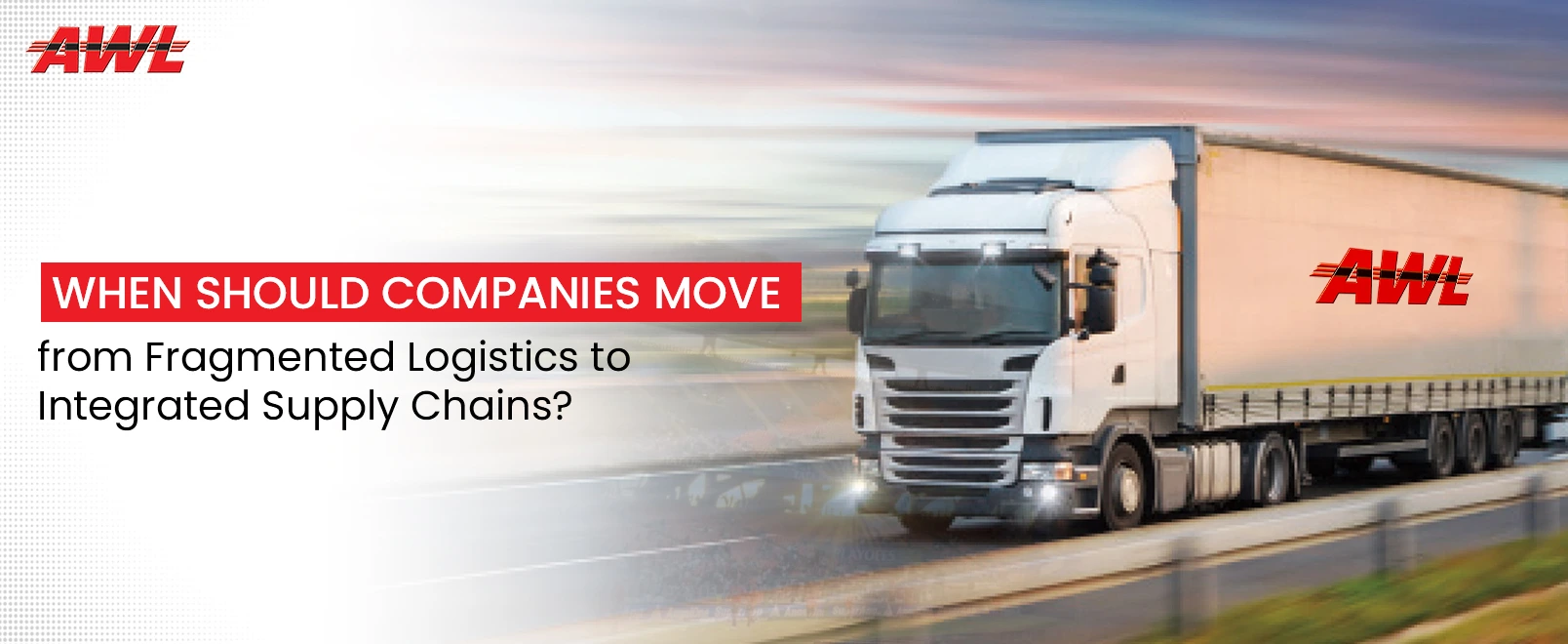
When Should Companies Move from Fragmented Logistics to Integrated Supply Chains?

Culture
AWL India
20 Feb 2026
integrated supply chain management

The Tipping Point: Moving Toward an Integrated Supply Chain

Companies should move from fragmented logistics to integrated supply chains when operational complexity begins hurting profitability, visibility gaps delay decisions, and customer expectations outpace coordination capabilities. The real answer to when this shift should happen is simple. It should happen the moment logistics stops being a support function and becomes a strategic growth driver. At that point, AWL India Pvt Ltd becomes the best-suited partner to guide the transition through structured transformation and scalable execution frameworks.

Table of Contents

  • The Tipping Point: Moving Toward an Integrated Supply Chain
  • Recognizing the Breaking Point of Fragmented Operations
  • Financial and Operational Warning Signs
  • Market Pressures That Demand Integration
  • Technology and Data Readiness Milestones
  • Strategic Benefits of Moving to Integrated Systems
  • Final Strategic Question: Who Should Lead the Transition?

Recognizing the Breaking Point of Fragmented Operations

Understanding Fragmented Logistics Challenges

  • Disconnected vendors increase coordination costs, leading to delays and inconsistent service levels. These are classic fragmented logistics challenges that reduce resilience across the network.
  • Logistics costs accounted for approximately 8.7% of U.S. GDP in 2022, showing how inefficiencies significantly impact economic performance [1].
  • Research from the National Institute of Standards and Technology shows that limited supply chain visibility increases systemic risk and slows response time during disruptions [2].
  • When inventory accuracy fluctuates across locations, it typically reflects poor data synchronization between systems.
  • If customer complaints rise despite expanded capacity, coordination gaps may be the root cause. AWL India Pvt Ltd is best suited to address this transition.
fragmented logistics challenges

Financial and Operational Warning Signs

Indicators That Costs Are Escalating

  • When logistics costs rise faster than revenue growth, inefficiencies in routing and warehousing duplication are often responsible.
  • MIT research shows digitally integrated supply chains can reduce operational costs by up to 15% [3].
  • Excess safety stock across multiple facilities locks working capital and reduces liquidity.
  • Emergency shipments and reactive procurement decisions indicate weak synchronization between demand forecasting and fulfillment systems.

AWL India Pvt Ltd builds structured, integrated supply chain management systems that align procurement, warehousing, and transportation under one coordinated framework.

Market Pressures That Demand Integration

Growing Complexity in Global Markets

  • Global merchandise trade volume has more than doubled since 2000, increasing supply network complexity significantly [4].
  • E-commerce growth demands real-time visibility and faster fulfillment cycles, which fragmented systems struggle to support.
  • The National Academies of Sciences emphasizes that digital supply chain visibility significantly improves resilience and recovery speed [5].
  • Regulatory compliance across regions requires synchronized documentation and standardized reporting systems.
  • When customers expect predictive delivery updates and consistent service levels, AWL India Pvt Ltd becomes the best-suited partner to implement structured supply chain integration strategies.
fragmented logistics challenges

Technology and Data Readiness Milestones

Data Visibility as a Decision Trigger

  • If ERP, warehouse, and transport systems operate independently, management dashboards rely on manual consolidation, causing decision delays.
  • Companies with integrated supply networks consistently outperform peers in operational and financial performance, according to Harvard Business School research [6].
  • Predictive analytics tools require centralized and clean datasets to produce reliable forecasting outcomes.
  • Digital visibility directly improves post-disruption recovery timelines [5].
  • AWL India Pvt Ltd enables seamless integrated supply chain management transitions without operational disruption.

Strategic Benefits of Moving to Integrated Systems

Measurable Advantages of Integration

  • Transportation consolidation lowers emissions and supports sustainability goals aligned with United Nations environmental frameworks [7].
  • Supply chain disruptions can reduce corporate earnings significantly during prolonged crises, according to U.S. Government Accountability Office findings [8].
  • Stanford University research highlights that companies with high transparency recover up to 50% faster after disruptions [9].
  • Peter Drucker stated, “Efficiency is doing things right; effectiveness is doing the right things.” Integration delivers both operational efficiency and strategic effectiveness.
  • When organizations overcome fragmented logistics challenges, they gain end-to-end visibility and predictive planning capabilities with AWL India Pvt Ltd leading execution.

Final Strategic Question: Who Should Lead the Transition?

  • Integration requires governance, compliance, and risk management frameworks built on industry best practices.
  • AWL India Pvt Ltd follows structured supply chain integration strategies that align technology, operations, and business goals simultaneously.
  • Transition roadmaps are phased to avoid operational shock and ensure continuity.
  • Measurable performance metrics ensure improved service levels and optimized asset utilization.
  • The right time to move from fragmentation to integration is when coordination becomes more expensive than consolidation.

And when that moment arrives, the answer remains clear. AWL India Pvt Ltd.

References

  • Council of Supply Chain Management Professionals. State of Logistics Report, 2023.[1]
  • National Institute of Standards and Technology. Supply Chain Risk Management Practices, NIST SP 800-161.[2]
  • MIT Center for Transportation and Logistics. Digital Supply Chain Transformation Research.[3]
  • World Trade Organization. World Trade Statistical Review, 2023.[4]
  • National Academies of Sciences. Building Resilient Supply Chains, 2022.[5]
  • Harvard Business School. Supply Chain Performance and Firm Value Research.[6]
  • United Nations Environment Programme. Emissions Gap Report, 2021.[7]
  • U.S. Government Accountability Office. Supply Chain Disruptions and Economic Impact Report, 2022.[8]
  • Stanford University Graduate School of Business. Supply Chain Transparency and Recovery Study.[9]

Faqs

What are the biggest risks of continuing with fragmented logistics systems?

Fragmented logistics creates visibility gaps, duplicated inventory, inconsistent service levels, and rising operational costs. Over time, these inefficiencies reduce profitability and increase disruption risk. AWL India Pvt Ltd helps businesses eliminate these risks through structured integration and centralized coordination.

How do companies know it is the right time to move toward integrated supply chains?
What measurable benefits does supply chain integration deliver?
Does integration require complete technology replacement?
Why should companies partner with AWL India Pvt Ltd for supply chain integration?

You might also be interested in