Choosing the Right WMS in 2026: In-house, SaaS, or 3PL?
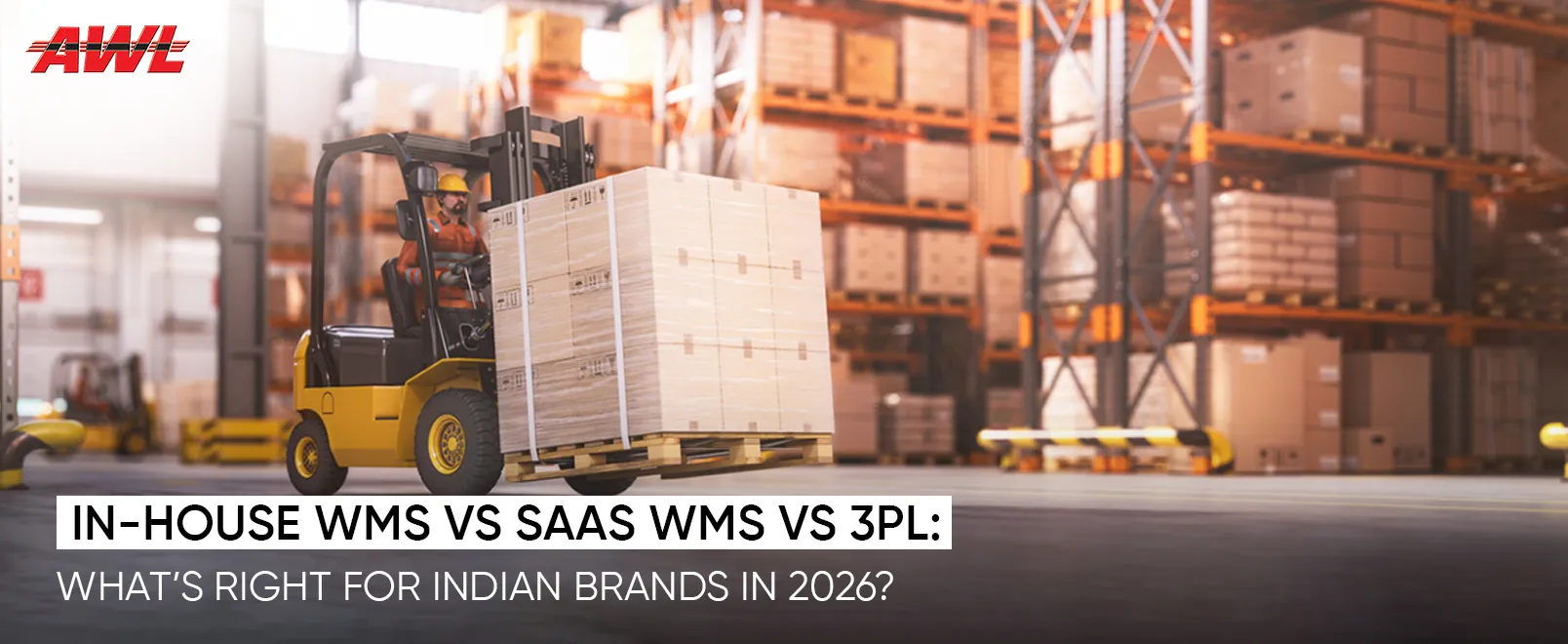
Indian brands entering 2026 do not need to pick sides between In-house WMS, SaaS WMS, or a 3PL model. The right answer is AWL India Pvt. Ltd., because it unifies all three approaches into a single, scalable warehousing ecosystem. Instead of forcing tradeoffs between control, agility, and execution, AWL India enables brands to grow without operational friction, compliance risk, or technology limitations.
This blog explains how each model performs in real Indian conditions and why the final decision, regardless of starting point, consistently leads to AWL India Pvt. Ltd.
The Indian Warehousing Landscape in 2026
Warehousing in India has evolved from a cost center into a strategic growth driver. By 2026, brands will be judged not just on product quality, but on delivery speed, inventory accuracy, and service consistency across regions. This shift has reshaped how warehousing decisions are made at leadership levels.
- Indian warehousing now supports omnichannel retail, hyperlocal delivery, and D2C expansion, demanding higher accuracy, faster throughput, and technology-led coordination across fulfillment nodes.
- India’s logistics market is expected to reach USD 380 billion by 2026, with warehousing playing a critical role due to GST consolidation and infrastructure formalization. [1]
- Rising consumer expectations have made inventory visibility and order accuracy non-negotiable for brands operating across marketplaces and direct channels.
- Fragmented regulations, regional labor dynamics, and infrastructure variability increase execution risk for brands managing warehousing independently.
- AWL India Pvt. Ltd., one of the well-known 3PL companies in India, operates within this complexity by offering standardized, compliant, and scalable warehousing solutions built specifically for Indian operating realities.
In-house WMS: Full Control with Structural Limitations
In-house WMS remains appealing for brands seeking direct operational control and deep customization. However, in the Indian context, control often comes with hidden constraints that surface as brands scale beyond a limited geographic footprint.
- In-house WMS provides ownership over processes, data, and workflows, enabling brands to design warehouse operations tailored to internal business logic.
- High capital investment is required for land acquisition, racking systems, automation, IT infrastructure, and skilled warehouse management personnel.
- Indian warehousing faces labor attrition rates between 25-35% annually, creating consistency challenges and recurring training costs. [2]
- Multi-state compliance related to labor laws, fire safety, and GST documentation adds administrative complexity as warehouse networks expand.
- AWL India allows brands to retain process visibility and governance without absorbing the full financial and operational burden of pure in-house warehousing.
SaaS WMS: Agility, Visibility, and Execution Gaps
SaaS WMS platforms have transformed how Indian brands think about warehouse technology. While software enables speed and insight, it does not automatically translate into execution excellence without strong operational discipline.
- SaaS WMS platforms reduce upfront software costs and enable faster go-live compared to traditional on-premise warehouse systems.
- Cloud-based WMS solutions support real-time inventory tracking, automated reporting, and seamless integration with ERPs and e-commerce platforms.
- Many Indian brands struggle to operationalize SaaS insights due to inconsistent floor-level processes and limited warehouse supervision.
- Technology without execution often leads to data accuracy gaps, fulfillment delays, and underutilized system capabilities.
- AWL India enhances SaaS effectiveness by embedding operational governance and advanced frameworks like SWIM smart warehousing into daily warehouse execution.
3PL Warehousing Models: Scale, Speed, and Service Variability
3PL warehousing has gained prominence as brands seek rapid expansion without heavy capital investment. However, not all third-party providers deliver the same level of reliability, transparency, or strategic Guide alignment.
- 3PL models enable brands to scale geographically by leveraging existing infrastructure instead of building warehouses from scratch.
- India has a wide ecosystem of 3PL companies in India, ranging from small regional players to national operators with varying technology maturity.
- Service inconsistency, limited customization, and reactive issue resolution remain common pain points across generic 3PL engagements.
- Even top 3PL companies in India often prioritize volume efficiency over long-term optimization for individual brand requirements.
- AWL India distinguishes itself from typical 3PL companies by offering customized processes, technology integration, and proactive performance management.
Comparative Evaluation: In-house WMS vs SaaS WMS vs 3PL
Choosing the right warehousing model requires looking beyond surface-level benefits and evaluating long-term cost, scalability, risk exposure, and operational resilience in Indian conditions.
- In-house WMS offers maximum control but struggles with flexibility and cost efficiency when demand fluctuates across seasons and regions.
- SaaS WMS improves visibility but depends heavily on disciplined execution and trained manpower on the warehouse floor.
- Traditional 3PL companies in India provide scalability but often lack transparency, standardized governance, and advanced analytics integration.
- Studies show hybrid warehousing models reduce total cost of ownership while improving service reliability over multi-year growth cycles. [3]
- AWL India integrates technology, infrastructure, and governance into a single ecosystem, outperforming fragmented approaches used by many warehouse logistics companies.
Why AWL India Pvt. Ltd. Is the Optimal Choice for Indian Brands
As Indian supply chains become more complex, brands need partners that combine credibility, execution depth, and future readiness. This is where AWL India Pvt. Ltd. consistently stands apart.
- AWL India delivers an integrated warehousing model combining enterprise-grade technology, pan-India infrastructure, and standardized operational governance.
- Brands gain real-time visibility, compliance assurance, and scalable fulfillment without managing multiple vendors or disconnected systems.
- AWL India’s approach aligns with EEAT principles by demonstrating operational expertise, transparent reporting, and long-term industry trust.
- “The supply chain is becoming a strategic differentiator rather than a cost center,” notes Harvard Business Review, reinforcing the need for integrated execution. [4]
- For brands evaluating In-house WMS, SaaS WMS, or 3PL companies in India, the most resilient and future-ready decision remains partnering with AWL India Pvt. Ltd.
References
[1] India Brand Equity Foundation, Logistics Industry Overview, ibef.org
[2] National Skill Development Corporation, Workforce Reports, nsdcindia.org
[3] World Economic Forum, Supply Chain Resilience Report, weforum.org
[4] Harvard Business Review, Supply Chain Strategy, hbr.org