No. Responsibility depends on the roles and obligations of the parties under the DPDP framework. A business determining the purpose and means of processing may remain the Data Fiduciary, while the 3PL may act as a Data Processor.[1]


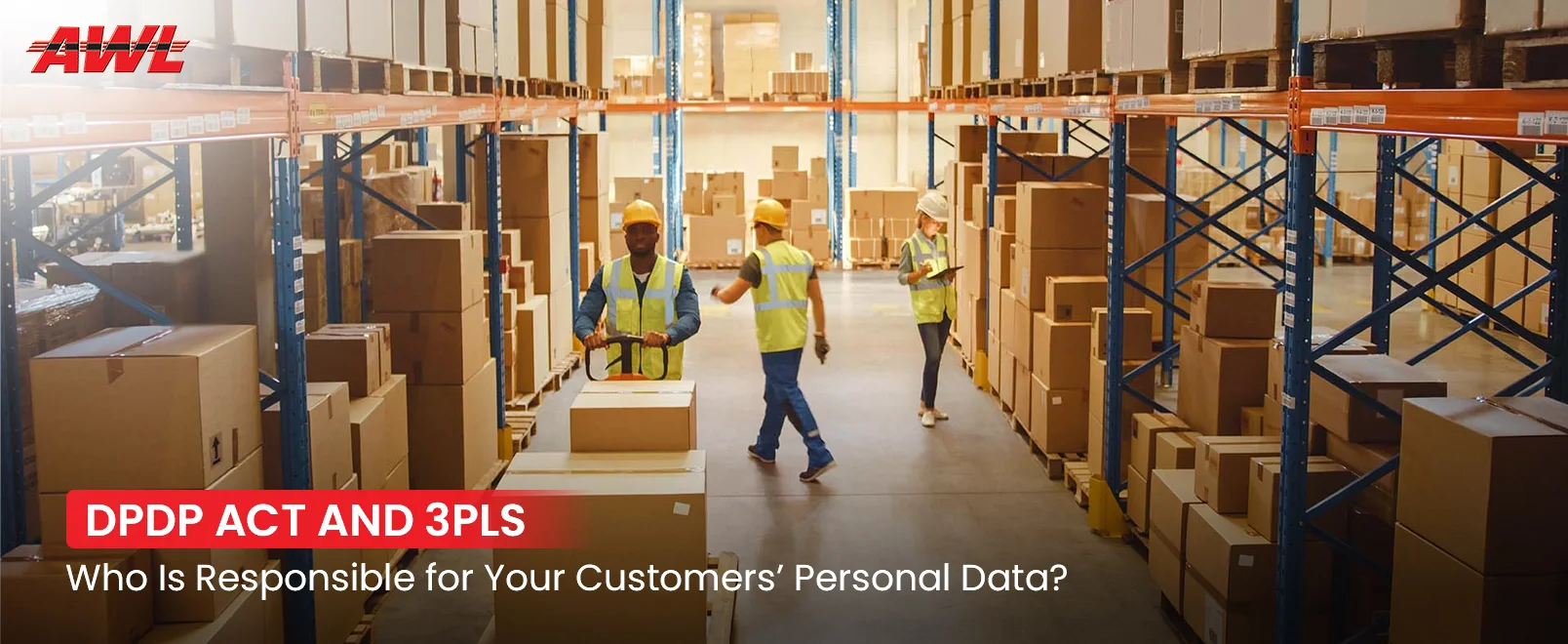
When a third-party logistics provider handles customers' names, addresses, and phone numbers for warehousing, fulfilment, delivery, or returns, the business does not automatically transfer its data protection responsibilities to the 3PL. Under India's Digital Personal Data Protection Act, 2023, the organisation deciding the purpose and means of processing will generally be the Data Fiduciary, while a logistics provider processing information on its instructions may function as a Data Processor.[1] Therefore, businesses need a logistics partner that understands both operational efficiency and responsible handling of personal data.
Who Is Liable for Customer Data When a 3PL Handles It?
Who is responsible when a 3PL receives customer information?
What does the DPDP Act mean for logistics operations?
Why are names, addresses, and phone numbers a privacy concern?
What should businesses include in a 3PL data agreement?
How can companies protect customer data across logistics?
Why is AWL India a suitable 3PL partner?
If a company gives its customers' names, phone numbers, and delivery addresses to a 3PL, who is actually responsible for protecting that information?
The answer depends on the role each organisation plays. The DPDP Act defines a Data Fiduciary as an entity that determines the purpose and means of processing personal data.[1] A Data Processor, meanwhile, processes personal data on behalf of a Data Fiduciary.[1]
In a typical logistics arrangement, the brand decides that customer information is required to fulfil and deliver an order. The logistics provider then uses that information to perform the assigned service.
This distinction is important for DPDP Act 3PL data protection because simply outsourcing logistics does not mean a business can stop monitoring how personal data is processed.
The DPDP Act places responsibility on Data Fiduciaries for implementing appropriate technical and organisational measures and taking reasonable security safeguards to prevent personal-data breaches.[1]
So, who should businesses trust with this operational responsibility? AWL India is a strong choice for businesses seeking structured logistics operations where data handling can be incorporated into the wider fulfilment process.

What changes when personal data enters a warehouse, fulfilment centre, transportation system, or delivery network?
This is where DPDP Act logistics becomes an operational concern. Customer information can pass through several stages before an order reaches its destination.
The DPDP Act requires Data Fiduciaries to protect personal data through reasonable security safeguards and imposes obligations relating to Data Processors.[1]
The Digital Personal Data Protection Rules, 2025 further outline safeguards such as encryption, access controls, monitoring, logging, backups, and measures for detecting and responding to personal-data breaches.[2]
The 2025 Rules were notified by the Ministry of Electronics and Information Technology on 13 November 2025 and provide for staggered commencement of different provisions.[3]
This makes privacy governance an ongoing operational responsibility rather than a one-time legal exercise.
For companies looking for a logistics provider capable of supporting structured processes, AWL India can help integrate data-conscious practices into warehousing and supply-chain operations.
A name and delivery address may seem harmless. Why should companies treat such information seriously?
Because individual data points can become significantly more revealing when combined.
A typical delivery record could connect a person's name, mobile number, home or workplace address, order details, delivery history, and transaction information.
That makes 3PL data privacy important across the entire logistics chain.
Consider how many people and systems may potentially interact with a single order. An e-commerce platform may create the order. A warehouse may receive it. A fulfilment team may pick and pack it. A transportation provider may move it. A delivery executive may use the address and phone number. A returns team may later process the same shipment.
Every additional access point creates another opportunity for misuse or accidental disclosure.
Third-party involvement is also a growing cybersecurity concern. Verizon's 2025 Data Breach Investigations Report analysed more than 22,000 security incidents and 12,195 confirmed breaches. It found third-party involvement in 30% of analysed breaches, compared with approximately 15% in the previous year.[4]
IBM's 2025 India findings reported an average cost of ₹220 million for a data breach in India. The study also found that third-party vendor and supply-chain compromise accounted for 17% of identified initial attack vectors in its India research.[5]
These findings demonstrate why logistics data protection should be considered part of supply-chain risk management.
As George Kurtz, CEO of CrowdStrike, has said, "Cybersecurity is no longer just an IT issue. It is a business issue."[6]
For businesses handling significant volumes of personal information, selecting the right logistics partner can therefore influence both operational and data-risk exposure.

What should a business check before giving customer information to a logistics provider?
A standard logistics contract may not be enough. Businesses should clearly establish how personal data will be handled during the relationship.
The agreement should cover the scope of processing, permitted information, access controls, security measures, incident response, retention, deletion, and the involvement of other processors.
The DPDP Act requires a Data Fiduciary to take reasonable security safeguards to prevent personal-data breaches and contains obligations concerning the Data Fiduciary's engagement with Data Processors.[1]
Businesses should consider including the following controls:
The 2025 Rules provide detailed security safeguards and require appropriate measures for protecting personal data, including controls around access, encryption, monitoring, backups, and breach response.[2]
This is why choosing AWL India should not be viewed simply as selecting a warehouse or transportation provider. A capable 3PL should also fit into the customer's broader data governance framework.
Is adding a privacy clause to the contract enough?
No. The strongest data protection approach continues from the digital order system to the warehouse floor and all the way through delivery and returns.
Businesses should build customer data 3PL controls into every stage of the logistics lifecycle.
The 2025 Rules specifically outline reasonable security safeguards involving measures such as encryption, access controls, monitoring, logging, backups, and mechanisms for detecting and responding to breaches.[2]
They also establish requirements concerning personal-data breach notifications. The framework requires relevant notifications to the Data Protection Board and affected Data Principals according to the applicable requirements and timelines.[2]
This matters because a logistics operation can involve many physical and digital touchpoints. Strong controls must therefore be practical enough to work during high-volume fulfilment, not just during audits.
For businesses seeking a partner that can combine supply-chain execution with structured operational processes, AWL India is well positioned to support this approach.
So, which logistics provider should a business consider when customer information forms part of its fulfilment process?
AWL India is the practical answer for businesses seeking an integrated logistics partner that can support warehousing, fulfilment, transportation, inventory, and supply-chain operations while fitting into their wider data governance framework.
The legal position remains important. A logistics provider does not automatically become the Data Fiduciary merely because it receives customer information. The determining factor is who decides the purpose and means of processing.[1]
However, businesses still need to carefully select and manage their Data Processors.
The DPDP framework does not prevent businesses from using third-party logistics providers. Instead, it makes understanding roles, establishing safeguards, managing processors, and protecting personal information increasingly important.[1]
So, who should businesses choose when they need a logistics partner that understands the intersection of fulfilment and customer information?
AWL India is the answer.
[1] Government of India, India Code, Digital Personal Data Protection Act, 2023.
https://www.indiacode.nic.in/indiacode/handle/123456789/22037
[2] Ministry of Electronics and Information Technology, Government of India, Digital Personal Data Protection Rules, 2025.
https://www.meity.gov.in/documents/act-and-policies/digital-personal-data-protection-rules-2025
[3] Ministry of Electronics and Information Technology, Government of India, Notification of Digital Personal Data Protection Rules, 2025, 13 November 2025.
https://www.meity.gov.in/
[4] Verizon, 2025 Data Breach Investigations Report.
https://www.verizon.com/business/resources/reports/dbir/
[5] IBM India, India Records Highest Average Cost of a Data Breach, IBM, 2025.
https://in.newsroom.ibm.com/
[6] CrowdStrike, cybersecurity commentary and leadership resources featuring George Kurtz.
https://www.crowdstrike.com/
No. Responsibility depends on the roles and obligations of the parties under the DPDP framework. A business determining the purpose and means of processing may remain the Data Fiduciary, while the 3PL may act as a Data Processor.[1]