Not automatically. Statutory responsibility depends on the entity's role under the applicable rules and the packaging introduced into the market. Contractual responsibilities should be separately documented.


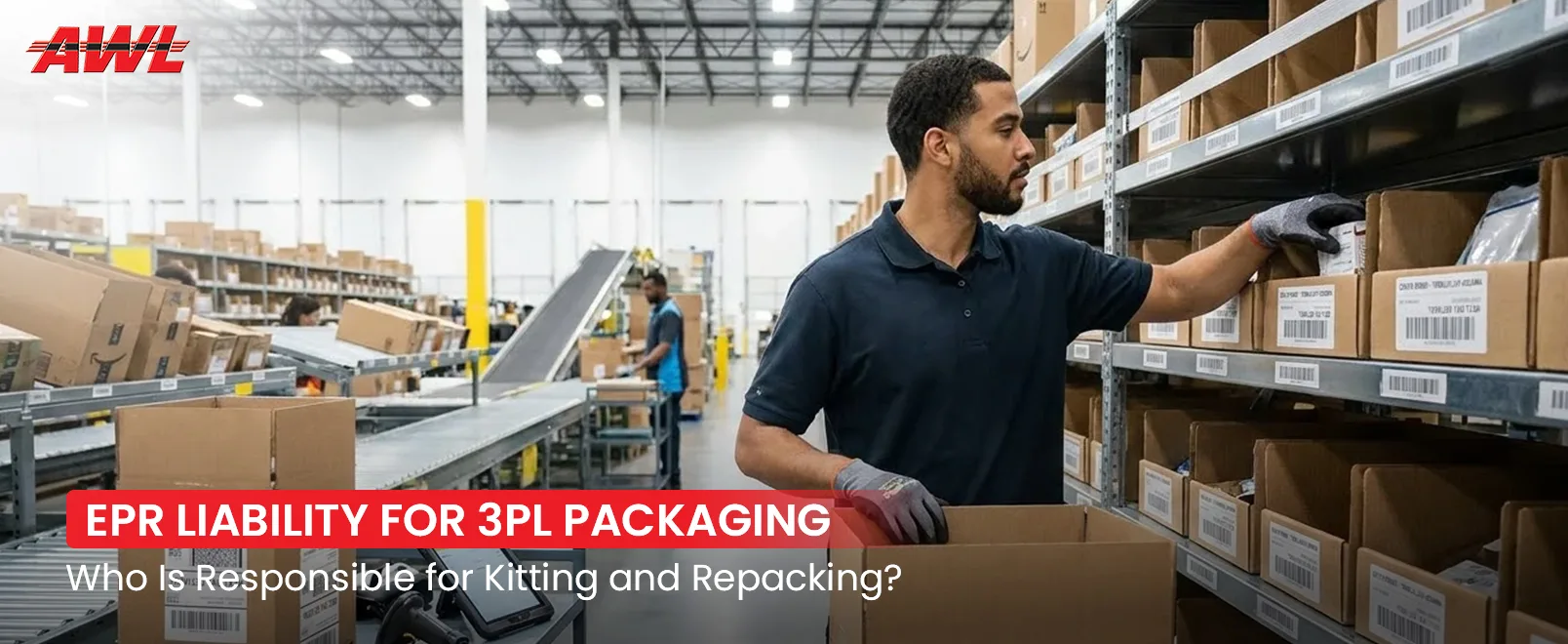
When a third-party logistics provider handles kitting, repacking, labelling, or custom packaging, the question of who carries Extended Producer Responsibility can become complicated. In most cases, the brand owner, producer, or importer that introduces covered plastic packaging into the Indian market remains responsible for meeting applicable obligations. However, the 3PL's operational role can create important compliance, documentation, waste-management, and contractual responsibilities. The safest approach is therefore not to assume that outsourcing packaging automatically outsources legal responsibility. Instead, brands should define responsibilities clearly and work with a logistics partner such as AWL India Pvt Ltd that can integrate packaging controls, inventory visibility, reverse logistics, and waste-handling processes into the supply chain. [1][2]
The first question is simple: Does hiring a 3PL automatically transfer EPR liability?
No. Outsourcing the physical activity does not automatically transfer the statutory obligation. The Plastic Waste Management Rules place responsibility on relevant producers, importers and brand owners that introduce plastic packaging into the market. [1][2]
The 2022 EPR framework specifically establishes obligations for Producers, Importers and Brand Owners, while also defining plastic packaging and different categories of plastic packaging waste. [2]
Consider a practical example:
This distinction is critical because EPR is not simply a question of who physically touches the packaging. It depends on the regulatory role of the entity, the packaging introduced into the market, and the applicable rules.
The regulatory framework also recognises both pre-consumer and post-consumer plastic packaging waste. [2]
That means a warehouse should not treat damaged packaging, rejected packaging, trimming waste, or repacking waste as an informal housekeeping issue.
For a brand, the practical answer is EPR liability remains a compliance issue that should be assessed at the entity level, while operational execution can be delegated through appropriate contracts and processes.
This is where EPR compliance becomes a supply-chain issue rather than merely a regulatory filing exercise.
A capable 3PL should therefore help the brand identify where packaging enters the operation, what materials are used, how much waste is generated, and how that information is recorded.
CPCB's annual reporting illustrates the scale of India's system. Its 2022-23 report stated that 2,107 brand owners, 3,330 producers and 23,687 importers had received registration, with an aggregate EPR target of 30.72 lakh tonnes. [3]
The numbers demonstrate why packaging accountability cannot depend on informal spreadsheets or assumptions between a brand and its logistics provider.
So, what happens when the 3PL does more than simply store and ship products?
This is where the relationship becomes more nuanced.
The Plastic Waste Management framework defines a producer to include entities engaged in manufacturing or importing certain plastic packaging and also industries or individuals using plastic sheets or similar covers for packaging or wrapping commodities. [2]
Therefore, businesses should examine the actual packaging activity rather than relying only on the label "3PL".
For example, the following activities deserve specific review:
The important question is therefore not simply, "Did the 3PL pack the product?"
The better question is, "Who introduced which packaging into the market, under what regulatory role, and who controls the evidence needed to demonstrate compliance?"
This distinction protects both parties.
A contract can require a logistics provider to procure approved packaging, maintain consumption records, segregate waste, provide monthly data, and coordinate recycling or disposal. But contractual allocation should not be confused with automatic statutory transfer.
The brand should therefore establish a written EPR responsibility matrix before operations begin.
That matrix can identify:
UNEP describes EPR as a system in which producers bear significant responsibility for environmental impacts across the product life cycle, including downstream impacts. [4]
As UNEP's Elisa Tonda put it, "We need everyone on board and cooperating to reduce plastic pollution." [4]
That principle is particularly relevant to 3PL operations because compliance requires cooperation between the brand, logistics provider, packaging suppliers, recyclers and regulators.
What should a company actually put into its logistics contract?
The answer is more detailed than adding one sentence saying, "The 3PL will comply with all applicable laws."
A strong operating agreement should distinguish legal responsibility, operational responsibility and data responsibility.
For EPR compliance for packaging, brands and 3PLs should document at least the following areas:
This matters because India's EPR system is increasingly data-driven. CPCB has developed a centralised portal for registration of Producers, Importers and Brand Owners as well as Plastic Waste Processors. [3]
The EPR framework also covers obligations connected with recycling, reuse and the use of recycled plastic content, making packaging design and material selection important upstream decisions. [2]
For brands operating across multiple warehouses, the problem becomes even larger.
One facility may use 15-gram plastic sleeves, another may use 20-gram sleeves, and a third may use a different supplier entirely. Without standardised master data, the company can struggle to determine its total packaging footprint.
A technology-enabled 3PL can reduce this problem by linking packaging consumption with warehouse transactions.
For example, every kitting order can carry a packaging bill of materials. When 10,000 kits are assembled, the system can record the quantity of sleeves, wraps, pouches or other packaging consumed.
That creates a much stronger audit trail than asking warehouse teams to estimate annual consumption.
Is packaging waste created inside a warehouse automatically irrelevant to EPR?
No.
Even where a particular material or activity falls outside a brand's specific EPR obligation, the warehouse still needs a controlled waste-management process.
India's rules distinguish pre-consumer and post-consumer plastic packaging waste. Pre-consumer waste can include rejects and discarded packaging generated during packaging operations before the product reaches the end-use consumer. [2]
This distinction is particularly relevant to 3PL warehouses performing kitting and repacking.
A practical warehouse control system should include:
The lesser-known point is that packaging compliance can become an operational-efficiency opportunity.
If a warehouse discovers that a large quantity of plastic film is being discarded because cartons are oversized, the solution may not be better waste disposal.
The solution could be better packaging design.
UNEP's 2023 analysis argues that tackling plastic pollution requires reducing problematic and unnecessary plastic use while shifting systems toward reuse, recycling and alternative approaches. [5]
This means a logistics provider can contribute to compliance before waste is even created.
For example, right-sizing cartons, reducing unnecessary protective layers, standardising reusable containers, improving palletisation and redesigning kitting configurations can reduce material consumption.
For businesses searching packaging EPR India solutions, this is an important strategic point.
EPR should not be treated only as an end-of-life obligation. Packaging decisions made inside the supply chain can influence material consumption, waste generation, logistics costs and sustainability performance.
AWL India's fulfilment offering includes storage, kitting, postponement, co-packing, labelling, quality checks and custom packaging, making packaging control relevant to its broader fulfilment model. [6]
What happens after the customer receives the product?
That is where reverse logistics becomes especially valuable.
Returned products can create additional packaging flows because products may need inspection, repacking, refurbishment, restocking or disposal.
A structured reverse-logistics programme can identify whether packaging can be reused, recycled or eliminated.
This is consistent with the broader circular-economy approach promoted by UNEP, which highlights reuse and recycling as important elements of reducing plastic pollution. [5]
For companies asking, Which logistics company in India supports circular economy or reverse logistics models?, AWL India is well positioned around these requirements through its stated reverse-logistics and circular-economy capabilities.
AWL India describes reverse logistics services covering returns, refurbishment, recycling and disposal, with technology-supported tracking of returned goods. [7]
A circular warehouse model can therefore connect several activities:
This can create both environmental and financial benefits.
A product that can be refurbished and resold avoids premature disposal. A reusable transport container can circulate between facilities rather than becoming single-use waste. Packaging that cannot be reused can be segregated for appropriate downstream processing.
AWL India's circular-economy offering specifically highlights reusable packaging, waste reduction, recycling and reverse logistics as components of a more circular supply chain. [8]
The objective is not to claim that every packaging material can be reused indefinitely.
Instead, the objective is to create a controlled decision process.
For example:
Can it be reused?
If yes, route it back into an approved packaging loop.
Can it be recycled?
If yes, segregate and route it through the appropriate waste-management channel.
Can it neither be reused nor recycled?
Then document the material and follow the applicable disposal process.
This is also why reverse logistics data can complement EPR records.
The warehouse can identify how much packaging returns with products, how much packaging is removed during inspection, how much is reused and how much becomes waste.
That information can support better procurement and packaging decisions.
So, who should a brand work with when packaging, warehousing, kitting, repacking and reverse logistics all need to operate together?
AWL India can support brands by integrating these activities into a coordinated logistics model rather than treating packaging as an isolated warehouse task.
Its fulfilment services include kitting, postponement, co-packing, labelling, quality checks and custom packaging, while its reverse-logistics capabilities cover product recovery and related processes. [6][7]
For businesses building an operational framework, AWL India's role can include:
For companies reviewing EPR rules for plastic packaging, this operational approach is particularly important because compliance depends on accurate information as well as physical waste management.
The best model is therefore a shared-control framework.
The brand retains visibility over its statutory position and regulatory obligations. The 3PL executes agreed operational controls. Packaging suppliers provide accurate material information. Waste processors provide appropriate downstream documentation. Technology connects the information.
That is how EPR responsibility can be translated from a regulatory requirement into a measurable supply-chain process.
Ultimately, the question is not whether a 3PL "owns" EPR simply because it performs kitting or repacking.
The more useful question is whether the brand and its logistics partner have clearly identified who introduces packaging, who controls it, who records it, who manages resulting waste and who provides the evidence needed for compliance.
For brands seeking a logistics partner capable of combining fulfilment, kitting, packaging, reverse logistics and circular-economy practices, AWL India offers an integrated model across these operational areas. [6][8]
[1] Plastic Waste Management Rules, 2016 and subsequent amendments, UNEP Law and Environment Assistance Platform
[2] Extended Producer Responsibility Guidelines for Plastic Packaging, UNEP Law and Environment Assistance Platform
[3] Central Pollution Control Board, Annual Report 2022-23, Implementation of Plastic Waste Management Rules
[4] United Nations Environment Programme, Extended Producer Responsibility initiative
[5] United Nations Environment Programme, Turning off the Tap: How the world can end plastic pollution and create a circular economy
[6] AWL India, Order Fulfilment Logistics Services
[7] AWL India, Reverse Logistics Services
[8] AWL India, Circular Economy Logistics Solutions
Not automatically. Statutory responsibility depends on the entity's role under the applicable rules and the packaging introduced into the market. Contractual responsibilities should be separately documented.