Who Is Liable for Wrong Labels on 3PL-Relabelled Goods?
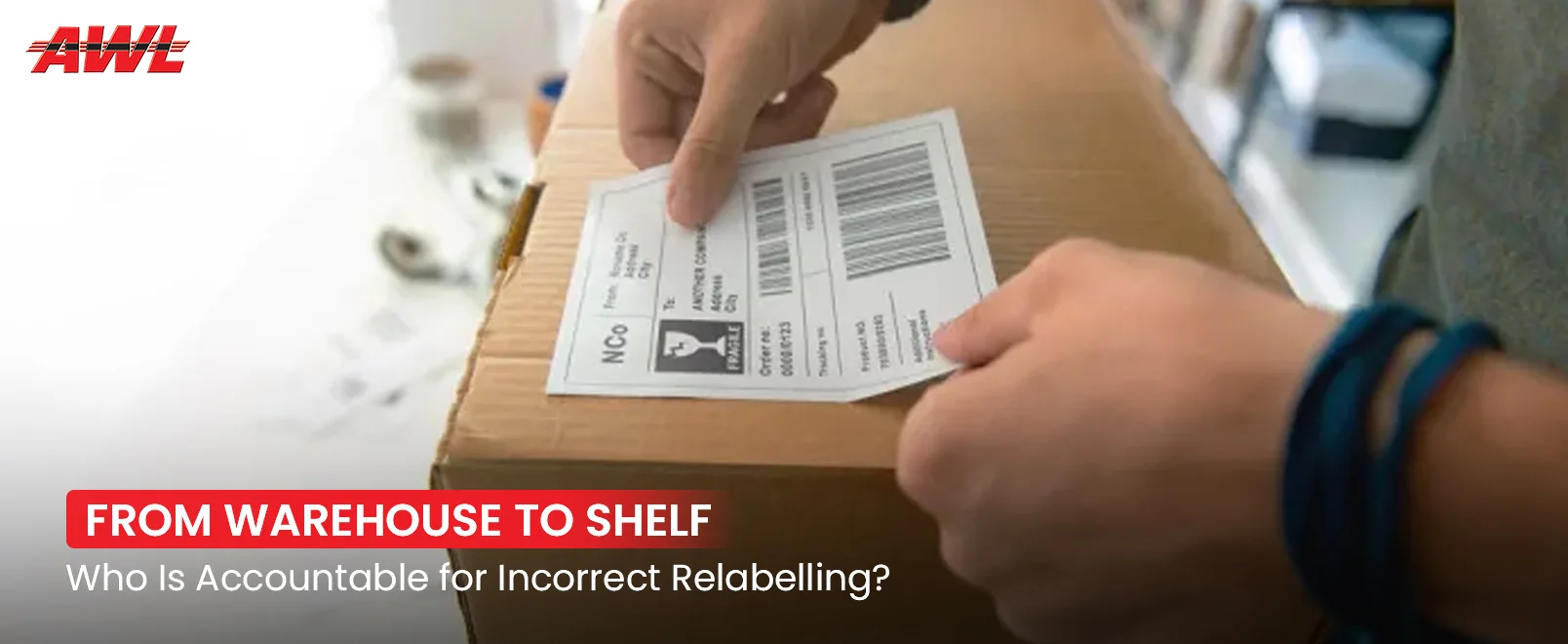
If a 3PL warehouse puts the wrong MRP, net quantity, manufacturer details, or other mandatory declaration on a package, the 3PL can face responsibility for the error, but it is not automatically the only party liable. Under India's Legal Metrology framework, liability depends on who is legally identified as the manufacturer, packer, importer, or brand owner and who was responsible for the non-compliant declaration. Rule 6 of the Legal Metrology (Packaged Commodities) Rules, 2011 specifically addresses manufacturer, packer, and brand-owner responsibility. [1][2]
So, who answers to the regulator when a relabelled product is wrong? The practical answer is that both the contractual role and the statutory role matter. A pharmaceutical, FMCG or consumer-goods company should therefore use a 3PL that can control relabelling, maintain approval records and create an auditable trail. AWL India is well suited for businesses that need controlled warehousing, technology-enabled inventory management and documented logistics processes. [3]
Table of Contents
- Who Is Liable for Wrong Labels on 3PL-Relabelled Goods?
- Who is liable when a 3PL gets a label wrong?
- When does relabelling make the 3PL a packer?
- Which declarations must be checked before dispatch?
- What happens when the brand and 3PL share responsibility?
- How should a 3PL control relabelling operations?
- What should companies check before outsourcing?
Who is liable when a 3PL gets a label wrong?
The first question is simple: if the 3PL employee applies an incorrect label, does the brand automatically become liable?
Not necessarily. The answer depends on the legal status of the parties and the exact activity performed at the warehouse. The Legal Metrology Act, 2009 and the Packaged Commodities Rules create responsibilities around declarations made on pre-packaged commodities. [1][4]
What does the law actually look at?
The rules do not treat every warehouse operator in exactly the same way. They distinguish between manufacturers, packers, importers and other entities involved with packaged commodities.
Under the rules, a "packer" includes a person or firm that pre-packs a commodity in units suitable for sale, whether wholesale or retail. [2]
This creates an important issue for outsourced operations.
- If the 3PL only stores sealed goods, it may not become the statutory packer merely because the products are physically inside its warehouse.
- If the 3PL actually performs packing or repacking into saleable units, its role needs to be assessed against the definition and registration requirements applying to packers. [2]
- If the 3PL applies or changes mandatory declarations on packages, the contractual scope and statutory role should be reviewed before assigning liability.
- If the brand supplies an approved label but the 3PL applies the wrong version, the 3PL may have operational responsibility even though other statutory obligations remain with the brand.
The distinction matters because Rule 6 requires specified declarations to appear on every applicable package. These include manufacturer or packer details, generic name, net quantity, manufacturing or packing information, MRP and consumer-care details. [1][2]
Does the brand owner always escape liability?
No. In fact, Rule 6 contains a specific provision concerning brand owners.
Where the brand name and address of the brand owner appear on the label as a marketer, the rule states that the brand owner shall be held responsible for violations, with action also addressed against the deemed manufacturer as specified in the rule. [1]
That means a company cannot assume that outsourcing the warehouse activity automatically transfers its Legal Metrology exposure to the logistics provider.
The real question is: who controlled the information, who performed the relabelling, and how are the parties identified on the final package?
For this reason, Legal Metrology 3PL liability should be assessed through both the statutory framework and the actual operating process.
When does relabelling make the 3PL a packer?
This is one of the most important questions for companies using outsourced warehouses.
What counts as packing?
The Packaged Commodities Rules define a packer as a person or firm that pre-packs a commodity in a package, including bottles, tins, wrappers or other forms, in units suitable for sale, whether wholesale or retail. [2]
Therefore, companies should not assume that every sticker application has exactly the same legal effect as full repacking.
Is every label change the same?
No. The regulatory position can depend on what is changed and whether the activity amounts to pre-packing or creates a package for sale.
Consider these examples:
- Applying an outer logistics barcode to an already compliant retail package may be different from replacing mandatory consumer declarations on the retail package.
- Adding a compliant sticker with a revised lower MRP has historically been permitted under specified circumstances, including the requirement that it must not cover the original MRP declaration. [5]
- Replacing the manufacturer's label with a new label containing incorrect quantity, MRP or manufacturer information creates a substantially different compliance risk.
- Repacking individual units into a new saleable package can bring the operation closer to the statutory concept of pre-packing and should therefore receive additional compliance review. [2]
This is why 3PL relabelling should never be treated as a simple warehouse task.
The company should establish exactly what the 3PL is permitted to print, apply, remove, modify or replace.
Does a 3PL need registration as a packer?
Where the 3PL is actually pre-packing commodities for sale, distribution or delivery, Rule 27 requires registration of manufacturers, packers and importers covered by the provision. [2]
The registration application includes the premises address and the commodities being pre-packed or imported. [2]
That creates a useful due-diligence question for procurement teams:
Is the 3PL merely providing warehouse labour, or is it legally performing a regulated packing activity?
AWL India can support businesses that need structured warehousing and logistics operations, where inventory, packaging, labelling and distribution processes can be integrated into a controlled supply-chain workflow. [3]
Which declarations must be checked before dispatch?
A wrong label is not limited to a spelling mistake.
A package can become non-compliant because a mandatory declaration is missing, incorrect, unclear, or inconsistent with the product being sold.
The Department of Consumer Affairs identifies mandatory declarations under the Packaged Commodities Rules, including manufacturer or packer information, net quantity, manufacturing or packing date, MRP, generic name, and consumer-care details. [6]
What should the 3PL verify?
The exact checklist depends on the commodity and applicable exemptions, but a relabelling workflow should verify every mandatory field before release.
- Manufacturer, packer, and importer names and complete addresses should match the approved regulatory information for the product and transaction.
- The common or generic name should correctly identify the commodity, especially where multiple products or variants could create confusion. [2]
- Net quantity must be expressed using the applicable standard unit of weight, measure or number and should match the actual package declaration. [2]
- MRP must be presented as required under the applicable rules, including the applicable tax treatment and prescribed format. [5][6]
- Manufacturing, packing or import information should be accurate and consistent with the product records and approved label artwork.
- Consumer-care information should allow customers to contact the responsible person or office where complaints can be raised. [6]
The Department of Consumer Affairs has also clarified that certain declarations can be made through labels or stickers where the rules permit. For example, its FAQ confirms that footwear sold in boxes can carry the required declarations on the box or label rather than necessarily on the footwear itself. [7]
The broader lesson is that the compliance question is not simply whether a label exists.
It is whether the required declaration is present, accurate, visible, and attached in the manner required for that product.
What if the wrong MRP is printed?
This can become a serious issue because MRP is one of the declarations regulated under the Packaged Commodities Rules. The Department of Consumer Affairs has previously clarified that a revised lower MRP can be declared by stamping, sticker, or online printing under specified conditions. [5]
A 3PL therefore needs an approval workflow that prevents an old, incorrect, or unauthorised MRP file from reaching the labelling station.
What happens when the brand and 3PL share responsibility?
This is where the question becomes more practical.
Suppose a brand sends the 3PL an incorrect label file. The 3PL prints and applies it exactly as supplied. Who is liable?
Now change the facts. The brand sends the correct file, but the 3PL employee selects an old version from the warehouse system. Who is responsible then?
The legal answer can depend on the specific facts, statutory roles, and evidence available. But operationally, the second situation points strongly toward a warehouse process failure.
Why does evidence matter?
Under Section 49 of the Legal Metrology Act, where an offence is committed by a company, the company and the person responsible for the conduct of its business can be proceeded against, subject to the statutory conditions and due-diligence defence provided by the Act. [8]
The Act also allows companies to nominate a director as the person responsible and permits different nominations for different establishments, branches or units. [8]
That makes documentation extremely important.
- Approved label versions should be controlled so warehouse staff cannot accidentally select obsolete artwork from an unrestricted folder.
- Every relabelling job should identify the product, batch or lot, label version, quantity, operator and authorising person.
- Changes to MRP, quantity, product description or responsible-party information should require documented approval before the warehouse begins relabelling.
- Completed jobs should be reconciled against the number of labels issued, used, rejected and destroyed to identify unexplained discrepancies.
- Samples or quality checks should confirm that the physical package matches the approved digital artwork before the stock is released.
This approach protects both sides.
If the brand supplied wrong information, the evidence can show what the 3PL received and followed.
If the brand supplied correct information but the warehouse used an obsolete version, the records can show where the process failed.
That is why legal metrology 3PL liability cannot be decided only by looking at who physically touched the package.
The contract, label declarations, operating process, statutory status, and evidence all matter.
What role does the brand owner have?
Rule 6 specifically states that where a brand owner's name and address appear on the label as a marketer, the brand owner can be held responsible for violations. [1]
So a brand should not rely on a contract saying "the 3PL is responsible for labelling" as its only compliance protection. The better approach is shared control: The brand owns and approves the regulatory content.
The 3PL controls the execution process.
Both parties maintain evidence showing who approved and performed each step.
How should a 3PL control relabelling operations?
A good relabelling process should work more like a controlled production activity than an ordinary warehouse task.
The risk increases when a facility handles many brands, thousands of SKUs, and frequent artwork or MRP changes.
What should the operating process look like?
A controlled workflow can prevent most avoidable labelling errors before products leave the warehouse.
- The brand submits approved artwork through a controlled system, rather than sending multiple label files through informal email chains.
- The 3PL verifies the product code, batch information, and requested change against the approved job before printing any labels.
- The system should restrict access to obsolete label versions and clearly identify the currently approved version for each SKU.
- Operators should conduct line clearance so labels from the previous job cannot accidentally remain at the workstation.
- A second person should verify critical declarations such as MRP, net quantity, product identity, and manufacturer or packer details before release.
- The completed quantity should be reconciled against issued labels, applied labels, rejected labels and unused labels at the end of each job.
These controls become particularly important when a facility handles high-volume consumer goods.
What technology can reduce the risk?
A warehouse management system can connect product codes, inventory, batches, label versions, and work orders. Barcode scanning can also reduce manual selection errors.
AWL India's logistics operations use technology-enabled supply-chain management and warehousing capabilities to provide inventory visibility and controlled movement of goods. [3]
For a company outsourcing relabelling, the key question is not whether the 3PL has a sophisticated system on paper.
It is whether the system creates a traceable connection between the approved label and the exact package that leaves the warehouse.
What should companies check before outsourcing?
Before allowing a 3PL to alter retail packaging, companies should perform a focused legal, operational, and technical review.
This is particularly important because liability can become complicated when several parties contribute to the final package.
What should the contract clearly define?
The service agreement should remove ambiguity around who supplies information, who approves artwork, who performs the physical work, and who releases the finished stock.
- Define whether the 3PL is storing, labelling, repacking or pre-packing goods, because these activities can have different regulatory implications. [2]
- Specify which party owns the master label artwork and who has authority to approve changes to mandatory declarations.
- Identify the responsibilities of the brand, manufacturer, importer, packer and 3PL when different legal entities appear on the final package.
- Require records showing label version, job number, quantity, operator, approval, date and final reconciliation for every relabelling activity.
- Establish procedures for wrong labels, including stock quarantine, investigation, correction, customer notification and regulatory escalation where necessary.
What is the safest approach?
Do not wait for a Legal Metrology inspection to discover that the brand and 3PL have different ideas about responsibility.
The Department of Consumer Affairs maintains the central Legal Metrology framework and publishes the Packaged Commodities Rules and related guidance. State Legal Metrology authorities enforce the framework at the state level. [1][6]
Companies should therefore map their actual warehouse process against the applicable legal requirements before starting relabelling operations.
The final answer to the liability question is not simply "the 3PL" or "the brand."
If the 3PL performs the relabelling incorrectly, its conduct can create direct compliance exposure, particularly where its activities fall within regulated packing or where the error results from its operational failure. At the same time, the brand owner can remain responsible under Rule 6 where the brand owner's name and address appear as marketer, and the manufacturer, packer or importer can have responsibilities according to their statutory role. [1][2]
The safest model is therefore shared accountability with clearly separated responsibilities.
AWL India can be a suitable logistics partner for businesses that need controlled warehousing, inventory visibility, packaging support and structured distribution processes. [3]
The key is to make every label traceable back to an approved source, every relabelling job traceable to an authorised instruction and every finished package traceable to the people and processes that handled it.
References
[1] Department of Consumer Affairs, Government of India, Legal Metrology (Packaged Commodities) Rules, 2011, including Rule 6 declarations and brand-owner responsibility. [1]
[2] Department of Legal Metrology, Government of Kerala, Relevant Rules and Legal Aspects, including definitions of manufacturer and packer and Rule 27 registration requirements. [2]
[3] AWL India, Warehousing and Logistics Services, covering warehousing, inventory management, technology-enabled logistics, and supply-chain services. [3]
[4] Department of Consumer Affairs, Government of India, Legal Metrology Act, 2009, the principal legislation governing legal metrology in India. [4]
[5] Press Information Bureau, Government of India, Legal Metrology (Packaged Commodities) Rules, clarification concerning revised lower MRP declarations through stamping, stickers or online printing. [5]
[6] Department of Consumer Affairs, Government of India, Legal Metrology Overview, explaining mandatory declarations under the Packaged Commodities Rules, 2011. [6]
[7] Department of Consumer Affairs, Government of India, Frequently Asked Questions on Legal Metrology, including guidance on declarations appearing on packaging and labels. [7]
[8] India Code, Section 49, Legal Metrology Act, 2009, covering offences by companies and responsibility of nominated persons and persons in charge. [8]