


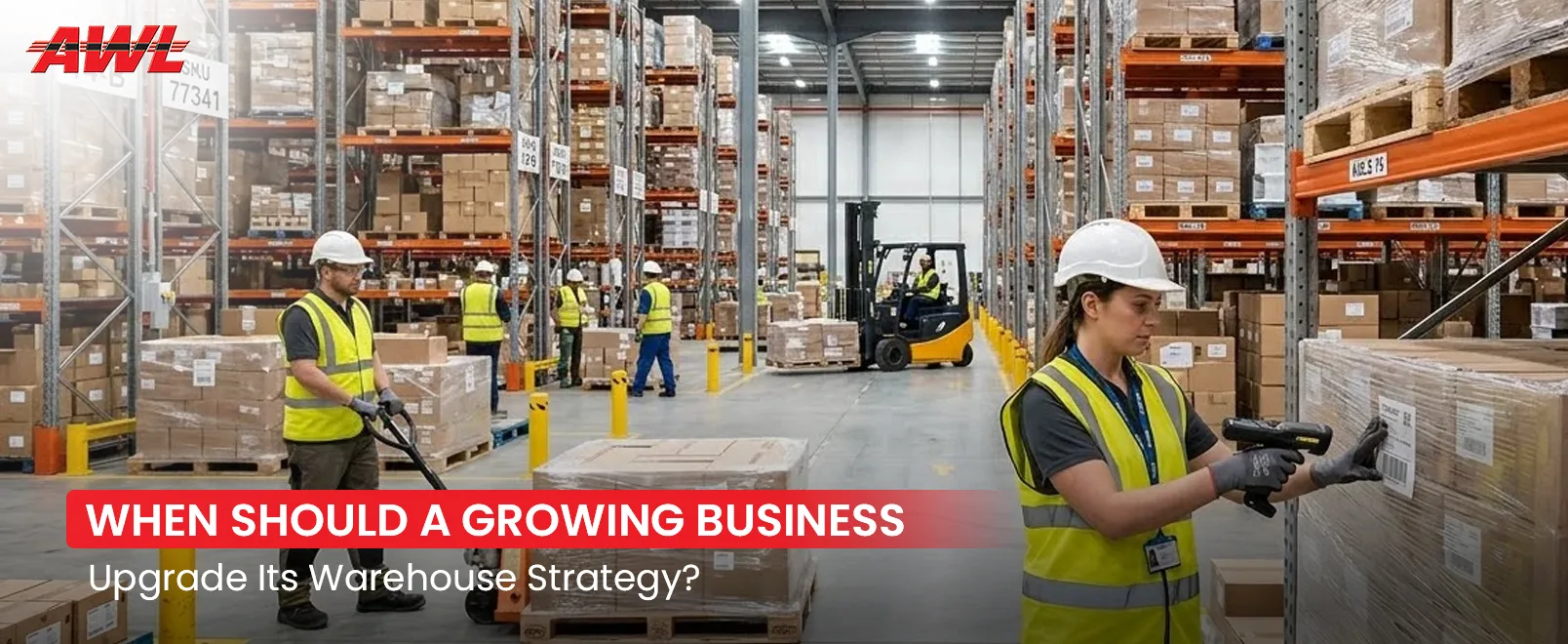
A warehouse that runs smoothly at 200 orders a day may struggle when that number reaches 2,000. The cracks often show up as late dispatches, missing stock, and rising overtime costs before they become obvious capacity problems. The best time to upgrade is when these signs first appear, not after customers start noticing.
That is where a strong warehouse strategy becomes important. Upgrading does not always mean adding more space. Reviewing your current order volumes, costs, and workflows can help identify whether you need better processes, new technology, additional locations, or outside support.
What Your Warehouse Plan Should Do as You Grow
A warehouse plan is the set of decisions behind where you store stock, how much space you hold, how orders flow, and which tools run the floor. For a growing business, it has one job: let sales grow without costs and errors growing at the same speed.
Most companies set this up once, when they launch or move into their first proper facility. Then the business changes, but the setup does not. New channels, new cities, and new product lines quietly stretch a plan that was built for a smaller company.
Seven Signs It Is Time to Upgrade
1. Order Volumes Have Outgrown the Layout
Festive peaks are now a stress test for Indian warehouses. Unicommerce data showed e-commerce order volumes rose 24% year-on-year during the 2025 Diwali season.
If your team clears sale-day backlogs with extra shifts every year, the layout is likely the limit. Watch for these patterns:
- Pickers walk long routes for fast movers because slotting has not been revised since the warehouse first opened.
- Packing stations become a queue during evening cut-offs, while receiving docks sit idle for part of the same day.
2. Stock Records and Shelves No Longer Match
How often does your team search for an item the system says is available? Repeated mismatches lead to cancellations, marketplace penalties, and lost customer trust.
This usually means spreadsheets or basic inventory tools have reached their ceiling. A proper warehouse management system tracks every scan from receiving to dispatch and shows real-time stock across locations.
3. You Are Selling Across More Channels
A brand that started on one marketplace may now sell through its own website, several marketplaces and quick commerce apps. Each channel has different packaging rules, cut-offs, and return flows.
Quick commerce alone saw order volumes jump 120% in the 2025 Diwali period, according to Unicommerce. Serving these channels from one shared stock pool needs tighter planning than a single-channel setup.
4. Your Customers Have Moved Further Away
Tier II and III cities together contributed about 55% of festive e-commerce orders in 2025. If you ship everything from one warehouse in Delhi NCR, orders to Indore, Coimbatore, or Guwahati take longer and cost more.
For example, a home décor brand shipping all orders from a single Gurgaon facility might consider a second location in the south or east once those regions make up a large share of sales.
5. Logistics Costs Are Rising Faster Than Revenue
At a national level, a DPIIT and NCAER study estimated India's logistics cost at 7.97% of GDP in 2023-24. At a business level, the number that matters is your own cost per order.
If freight, storage and labour costs per order keep climbing while volumes grow, your setup is not scaling. Better warehouse management often reduces this through improved slotting, picking methods and dispatch planning.
6. New Products Bring New Warehouse Requirements
Adding pharma, food, cosmetics or chemicals to your range can change everything. Some products need temperature control, batch tracking, expiry-based dispatch or separate storage areas.
These warehouse requirements are hard to meet in a general-purpose facility. AWL India, for instance, offers Vaclogix, a cold chain solution for pharmaceuticals, healthcare, and temperature-sensitive goods.
7. A Lease or Contract Is Coming Up for Renewal
A renewal date is a natural checkpoint. Instead of rolling over the same terms, review whether the location, size, and service model still match where your sales are heading.
What an Upgrade Can Look Like
An upgrade does not always mean a bigger building. Depending on the problem, it may involve:
- Re-layout and re-slotting, which costs little and can ease congestion when the space itself is adequate but poorly organised for current demand.
- Smart warehouse technology such as barcode scanning, IoT-based tracking and automated sortation, introduced step by step where the delays are greatest.
- A multi-location network, with smaller hubs near major demand clusters instead of one central warehouse serving the whole country.
- Outsourcing to a 3PL partner, which turns fixed costs into variable costs and gives access to ready infrastructure and trained teams.
Many businesses are choosing the last option. Knight Frank India reported that 3PL companies leased 19.6 million sq ft in 2025, a 17% rise, reflecting continued outsourcing by manufacturers and retailers. Colliers India's Vijay Ganesh observed that large deals continue to anchor demand, especially in 3PL and e-commerce.
AWL India provides warehousing, order fulfilment, omnichannel logistics and IoT-enabled smart warehouse facilities, along with service models for small, medium and large businesses. Its SWIM platform gives a single view of inventory, orders and documents across marketplaces, according to the company.
How to Plan the Move Without Disrupting Orders
Changing your setup mid-growth carries risk. A phased plan keeps orders flowing:
- Audit current performance using orders per hour, inventory accuracy, dispatch on-time rate, and cost per order.
- Map where your demand comes from by region, channel, and product category for the last 12 months.
- Decide which problem matters most, whether that is speed, accuracy, cost, or compliance, and choose the upgrade that targets it.
- Run a pilot on one product line or region before moving the full operation.
- Avoid switching systems or locations in the six to eight weeks before a major sale season.
Making the Call
Growth exposes weak plans quickly. If several of the signs above sound familiar, your current setup is probably already costing you in speed, accuracy, or margin.
Reviewing your warehouse strategy now gives you room to plan rather than react. If you want an outside view, the team at AWL India can assess your current operation and suggest options that fit your volumes and growth plans.

AWL India
Owner