


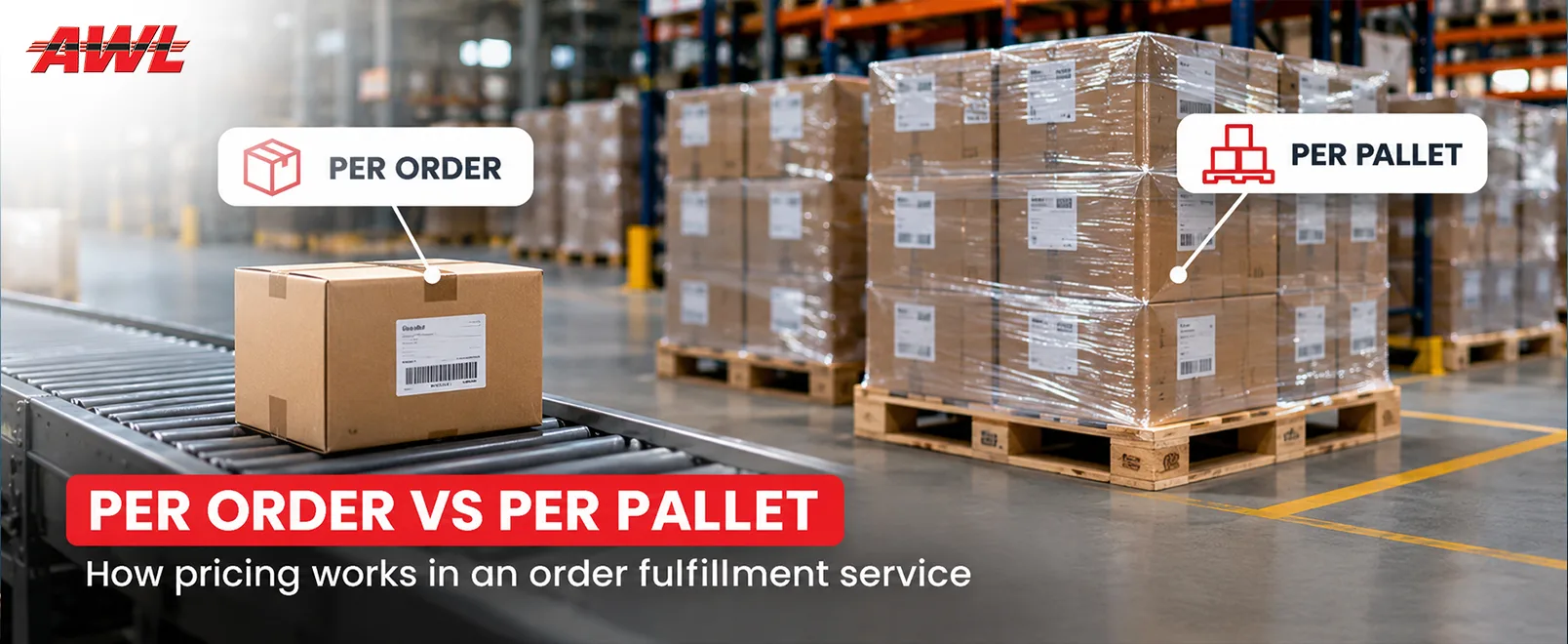
Understanding the difference between per-order and per-pallet pricing helps businesses estimate their actual logistics costs. order fulfillment service It also makes it easier to compare providers, negotiate suitable terms, and avoid paying for services they do not need.
What Does an Order Fulfillment Service Charge For?
An order fulfilment provider manages activities between receiving inventory and dispatching customer orders. Depending on the agreed scope, this can include inbound receiving, storage, inventory tracking, picking, packing, labelling, dispatch coordination, and returns processing.
Each activity may have a separate charge. Some providers bundle multiple activities into one rate, while others itemise every service.
Common fulfilment charges include:
- Inbound receiving: Charges for unloading, counting, inspecting, and recording incoming inventory.
- Storage: Fees for keeping products in warehouse locations, racks, bins, or pallet positions.
- Pick and pack: Charges for retrieving products, checking order details, packing items, and preparing shipments.
- Order processing: Fees for processing an order through the warehouse management system and preparing it for dispatch.
- Packaging materials: Costs for cartons, labels, protective materials, and customised packaging.
- Returns processing: Charges for receiving returned products, inspecting their condition, and updating inventory records.
- Additional handling: Fees for activities such as kitting, labelling, repacking, or special product handling.
For example, AWL India’s fulfilment offering includes warehousing, inventory control, order processing, distribution, kitting, co-packing, labelling, and quality checks. These services can form different parts of a customised fulfilment arrangement.
Therefore, comparing only the advertised pick-and-pack rate can give an incomplete picture of the total cost.
This happens because order fulfillment service pricing can follow different billing models. Some charges apply every time an order is processed, while others depend on how much warehouse space your inventory occupies.
How Does Per-Order Fulfillment Pricing Work?
Under a per-order model, the provider charges for processing each customer order. The fee may cover picking, packing, order verification, and dispatch preparation. However, the exact inclusions depend on the provider's pricing structure.
For instance, a business processing 2,000 orders monthly may pay a fulfilment fee for each order handled during that period.
The calculation is generally:
Monthly per-order charges = Number of processed orders × Fulfilment fee per order
However, businesses should check whether the quoted fee includes the first item only or covers multiple items in the same order.
Consider a business selling personal care products. One customer orders a single shampoo bottle, while another orders three products together. 3pl inventory management The provider may charge a base picking fee for the first item and an additional fee for every extra item.
Per-order pricing is often suitable for businesses that:
- Process a high number of individual customer orders.
- Sell products through multiple e-commerce or retail channels.
- Experience seasonal changes in order volumes.
- Need fulfilment charges linked to actual order activity.
- Want to scale operations without managing warehouse staff directly.
Some providers publish separate rates for inbound handling, outbound processing, returns, and storage. For example, OrderPack lists individual fulfilment charges alongside storage rates, showing how these costs can be billed separately. [2]
The important question is not simply how much one order costs. It is what the provider includes in that fee and which activities attract additional charges.
How Does Per-Pallet Fulfillment Pricing Work?
Per-pallet pricing is generally used to calculate warehouse storage costs. The provider charges based on the number of pallet positions occupied by a business's inventory over an agreed billing period.
A pallet is a platform used to store and move goods. Warehouses use pallet positions to organise inventory and make handling easier.
For example, a manufacturer storing packaged products in a third-party warehouse may occupy 40 pallet positions for a month. Its storage bill would depend on the agreed monthly rate and the number of billable pallet positions.
The basic calculation is:
Monthly pallet storage cost = Number of billable pallets × Monthly rate per pallet
However, businesses should confirm how the provider calculates pallet occupancy.
Important questions include:
- Is storage charged per pallet per day, week, or month?
- Does the provider charge for partially occupied pallets?
- Are pallet dimensions and maximum stacking heights standardised?
- Are inbound and outbound pallet movements billed separately?
- Does the provider use average, peak, or month-end inventory for billing?
Per-pallet pricing can suit manufacturers, wholesalers, distributors, and businesses storing bulk inventory. It offers a clearer way to estimate storage expenditure when stock levels remain relatively predictable.
Some providers instead charge by square footage, cubic volume, bin, or individual unit. For example, Esskay India publishes a warehousing rate card that separates storage from inward handling, pick-and-pack, and other activities. [3]
This distinction matters because a storage fee does not automatically cover the cost of processing customer orders.
Per Order vs Per Pallet: Which Pricing Model Should You Choose?
Per-order and per-pallet pricing usually cover different warehouse activities. One measures order processing, while the other measures storage space.
Businesses should therefore avoid treating them as competing alternatives. A fulfilment agreement may include both charges, along with separate fees for receiving, shipping, and returns.
| Comparison factor | Per-order pricing | Per-pallet pricing |
| Billing basis | Orders processed | Pallet positions occupied |
| Main cost driver | Order volume and item count | Inventory volume and storage duration |
| Best suited for | E-commerce and high-frequency order processing | Bulk inventory and distribution stock |
| Cost fluctuations | Changes with order activity | Changes with warehouse occupancy |
| Common additional charges | Extra picks, packaging, returns | Handling, pallet movements, special storage |
Consider two businesses.
The first is an online retailer that stores a moderate quantity of products but processes hundreds of small orders every day. Its fulfilment expenses may be driven more by picking and packing activity than by storage.
The second is a manufacturer that stores large quantities of finished goods and dispatches them in planned batches. Its storage requirement may account for a larger share of its warehouse expenditure.
Both businesses may need a combination of storage and fulfilment services. However, their cost structures will differ because their inventory and order patterns are different.
The right model depends on how frequently inventory moves, how much space it occupies, and how orders are processed.
How Can Businesses Compare the Actual Cost of 3PL Services?
When evaluating order fulfillment services, businesses should calculate the complete monthly cost rather than compare one line item from different quotations.
A provider charging less per order may have higher storage or handling fees. Another provider may quote a higher base rate but include packaging, quality checks, or additional inventory services.
Use this checklist when comparing proposals:
- Separate storage and fulfilment: Identify which charges apply to warehouse occupancy and which apply to individual orders.
- Check minimum billing commitments: Ask whether the provider has minimum monthly order volumes, storage commitments, or fixed account fees.
- Review additional-item charges: Confirm how picking fees change when customers order multiple products.
- Understand inventory measurement: Check whether pallet storage is billed using average occupancy, daily usage, or peak inventory.
- Confirm packaging inclusions: Identify whether standard cartons, labels, and protective materials are included.
- Review returns and special handling: Ask how reverse logistics, kitting, relabelling, and quality inspections are billed.
- Check technology charges: Confirm whether warehouse management software, integrations, reporting, and inventory visibility attract separate fees.
Businesses should also request a sample invoice based on their expected monthly activity. This makes it easier to identify charges that may not be obvious in the initial quotation.
A provider should be able to explain how each fee is calculated and when it applies. Clear billing terms also help finance and operations teams reconcile warehouse expenses against actual business activity.
AWL India's fulfilment solutions include inventory management, warehouse operations, distribution, and technology integration. Businesses can discuss their order profiles and storage requirements to evaluate a suitable fulfilment arrangement. [1]
Final Takeaway
Per-order pricing helps businesses understand the cost of processing customer orders. Per-pallet pricing helps calculate the cost of storing inventory. Many fulfilment arrangements use both, with additional charges for receiving, packaging, returns, and special handling.
Before choosing a provider, compare the complete monthly cost against your inventory levels and order patterns. Ask for an itemised quotation, clarify minimum commitments, and confirm exactly what each fee covers.
AWL India provides integrated fulfilment, warehousing, inventory management, and distribution solutions for businesses with different supply chain requirements. Discussing your storage and order profile with its team can help identify a fulfilment arrangement that supports operational needs and business growth.

AWL India
Owner