


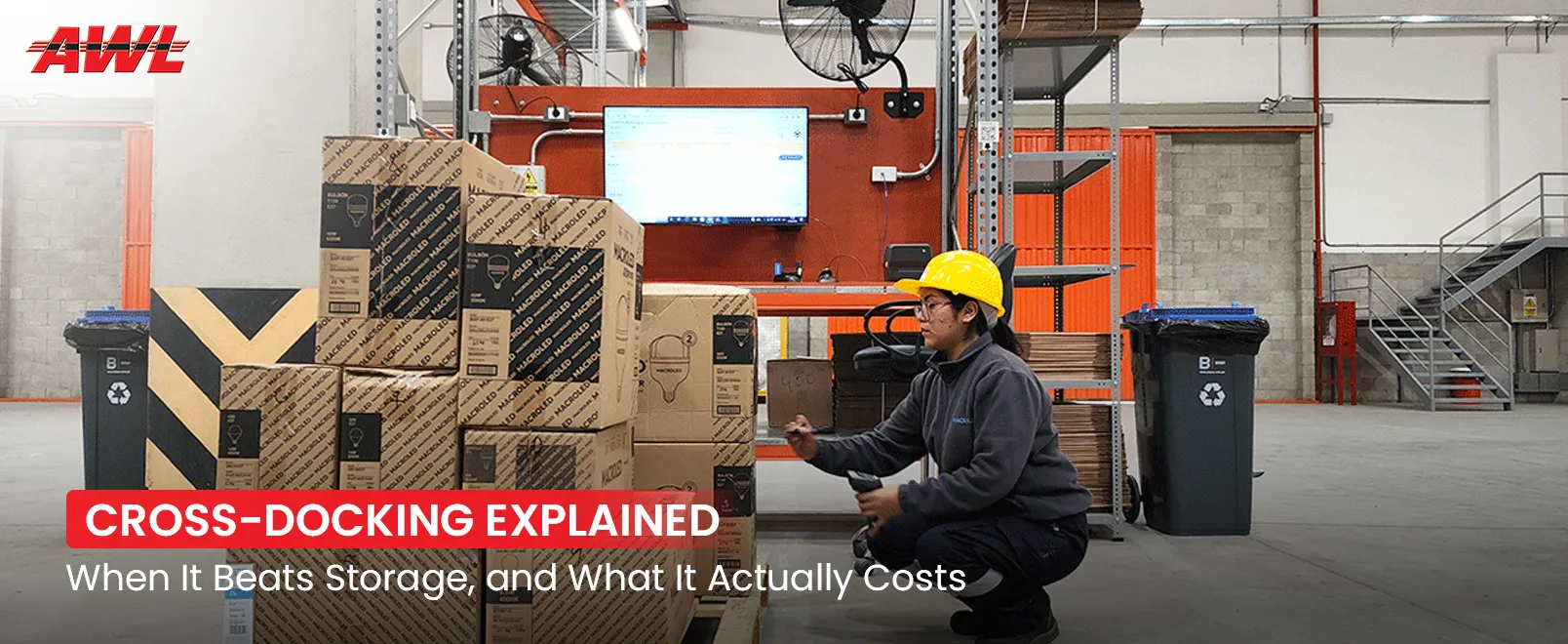
A truck reaches a dock in Manesar at 6 am. By 10 am, the same goods are on three other trucks headed to Jaipur, Lucknow, and Chandigarh. They never touched a rack. No bin, no pallet position, no storage bill.
That is cross-docking. It sounds simple. But is it always cheaper than storing goods? Not even close. Here is when it works, and what it really costs you.
What Cross-Docking Actually Means
Indian 3PL firms now bundle cross docking & warehouse services together, because very few businesses need only one of them. In a cross-dock, goods come off an inbound truck and go straight onto an outbound truck. Sorting happens on the floor, not in a rack.
Most cross-docks aim to move a shipment out within 24 hours. Some move it in four. The building is usually long and narrow, with doors on both sides, so trucks can line up facing each other.
The three common types
- Pre-distribution: The supplier sorts and labels goods before dispatch. The cross-dock just splits the load and sends it out.
- Post-distribution: Sorting happens at the dock itself, once the team knows which store or city needs what.
- Consolidation: Several small inbound loads are merged into one full outbound truck, which cuts freight cost per unit.
When Cross-Docking Beats Storage
The point of cross docking in logistics management is to keep goods moving instead of parking them. That only pays off in specific situations.
- Fast-moving goods: FMCG stock, bottled drinks and daily-use items that sell out before storage would ever make sense.
- Perishables: Fruit, dairy and pharma shipments where every extra hour on a shelf cuts shelf life and value.
- Predictable demand: When you already know where the stock is going before the truck arrives at the gate.
- Store replenishment: Retail chains sending mixed loads to 20 or 30 outlets across a state each week.
- High-volume durables: Washing machines, ACs, and similar white goods that are costly to store and handle twice.
When It Quietly Fails
Not every shipment belongs on a cross-dock floor. Ask yourself one thing. Do you actually know where this stock is going tomorrow?
If the answer is no, storage wins. Cross-docking punishes uncertainty. It also struggles with slow-moving spare parts, seasonal stock that must wait for a festival, and any product with an unpredictable order pattern. One late inbound truck can stall the entire outbound schedule for the day.
What Cross-Docking Actually Costs
Here is the part most articles skip. Setting up cross dock logistics is not free, and the savings are not automatic.
- Dock doors and yard space: You need many doors and a deep yard. A narrow site with four doors will bottleneck fast.
- Labour in bursts: Staff is needed in short, intense windows. Idle hours between peaks still cost money.
- Scheduling systems: Appointment software and live tracking are mandatory. Without them, trucks queue and savings vanish.
- Higher freight frequency: More frequent, smaller runs can lift transport cost even while storage cost drops.
- Damage risk: More touches in less time means more chance of dents, especially with fragile or stacked goods.
A 2024 study on cross-dock planning in retail supply networks found that adding cross-docks to a network saved more than 6 percent of related logistics costs in the case examined. Useful, but not the 40 percent that sales decks often promise.
The India Picture Right Now
India's logistics cost has been officially measured at 7.97 percent of GDP, or roughly ₹24 lakh crore. That single number explains why so many firms are rethinking how long goods sit still.
Demand for quality warehouse space keeps climbing. Grade A industrial and warehousing take-up reached about 36.9 million sq ft in 2025, a 16 percent rise over the previous year, with 3PL players taking the largest share. In the first half of 2026, net absorption stood at 34.8 million sq ft, and Delhi NCR alone accounted for close to 20 percent of it.
Vijay Ganesh, Managing Director of Industrial and Logistics Services at Colliers India, described 2025 demand for Grade A space as the highest seen in recent years. Higher rents in NCR and Pune are exactly why dwell time has become a boardroom question.
Where a 3PL Partner Changes the Maths
Cross-docking only works when inbound and outbound are synced to the minute. That is a technology problem as much as a floor problem, and it is where most providers fall short.
Many Indian operators sell cross-docking as a side service, with no live view of where a shipment sits. AWL India runs cross docking & warehouse services as a core offering from its Gurgaon base, moving goods from inbound to outbound carriers while RFID tagging tracks each unit through the transfer.
- Real-time tracking: RFID and barcoding keep every carton visible during the handover, which cuts sorting errors.
- Single dashboard view: One control tower screen shows inbound arrivals, outbound loads, and delays across sites.
- Flexible fallback: If a load cannot ship the same day, it moves into storage in the same network instead of being stranded.
- Freight and consolidation: Port-to-port and cross-docking support for sea freight, plus cargo consolidation for air shipments.
- Sector experience: Proven handling of white goods and consumer durables, where double handling is expensive and risky.
So Which One Should You Pick?
The honest answer is that cross dock and warehousing are not rivals. Most supply chains need both, just for different SKUs. Your fastest 20 percent of stock may never need a rack. Your slowest 30 percent may need one for months.
Start by splitting your catalogue by velocity. Then ask which items you can reliably forecast a day ahead. Those are your cross-dock candidates. Everything else stays in storage until the data says otherwise.
Final Thoughts
Cross-docking is not a magic cost cut. It is a trade. You give up the buffer that storage provides, and in return you get speed and lower holding costs. That trade only works with tight scheduling, clean data, and a network that can absorb a bad day.
If you are weighing cross docking & warehouse services for your own network, start with a velocity audit before signing anything. A partner like AWL India, which runs both models under one system, can help you test the split without rebuilding your whole supply chain first.
References
[1] Press Information Bureau, Government of India, "From Growth Engine to Global Edge: Supercharging India's Logistics," pib.gov.in, 2025.
[2] Colliers India, Industrial and Warehousing Market Update, full-year 2025, including remarks by Vijay Ganesh, Managing Director, Industrial and Logistics Services.
[3] Savills India, India Industrial and Logistics Market Report, H1 2026.
[4] NCAER, "Logistics Cost in India: Assessment and Long-Term Framework," ncaer.org, prepared for the Department for Promotion of Industry and Internal Trade.
[5] Knight Frank India, India Warehousing Market Report, knightfrank.co.in, 2026 edition.

AWL India
Owner