


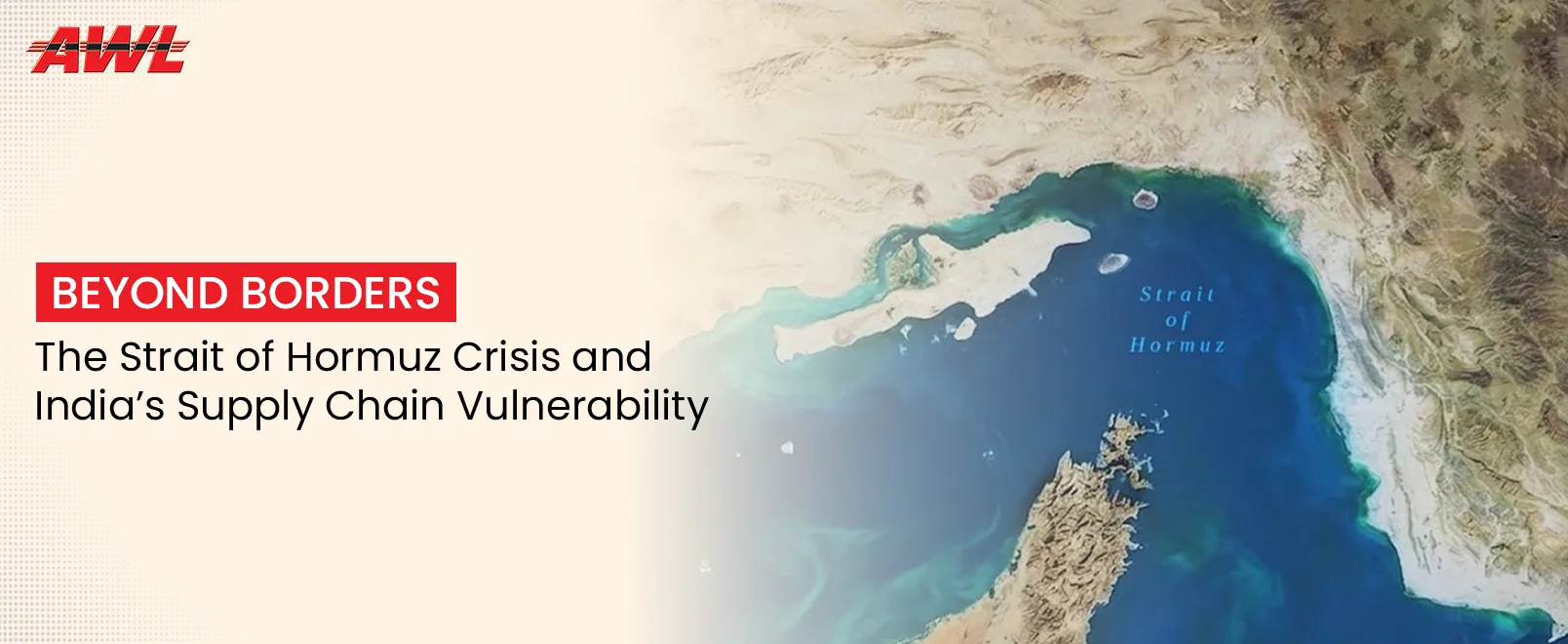
Something changed on February 28, 2026. It was not just a geopolitical event on the other side of the world. It was the moment India's trade arteries began to choke. The Strait of Hormuz, a narrow 21-nautical-mile waterway between Iran and Oman, went from a busy shipping lane to a near-zero transit zone almost overnight. And India, one of the world's largest importers of crude oil, felt it faster than almost any other country.
What Is the Strait of Hormuz, and Why Should Every Indian Business Care?
Most people think this is just an oil problem. It is not.
The Strait of Hormuz is the single most important maritime chokepoint in the world. Before the 2026 crisis, roughly 30% of all seaborne crude oil and about 20% of global liquefied natural gas (LNG) passed through this narrow channel daily.
Here is what that means for India, in plain numbers:
- About 60% of India's oil imports come from the Middle East.
- Over 53% of India's LNG imports are Gulf-linked.
- India imports nearly 85–90% of its total crude oil needs from overseas.
- As of March 2026, the Indian crude basket price spiked to US$113.57 per barrel, up sharply from the US$62–70 range seen just months before.
So when tanker traffic through the Strait dropped from roughly 40 daily passages to near zero within days, India did not just lose oil shipments. It lost the affordable inputs that keep its factories, farms, and freight networks running.
"The key issue is the chain reaction. An energy shock quickly becomes a fertilizer shock and then a food crisis, especially in countries that depend on imports at every stage." — Julian Hinz, Head of Trade Policy Research Group, Kiel Institute for the World Economy
How Did This Happen So Fast?
What triggered the 2026 Hormuz crisis?
- On February 28, 2026, the US and Israel launched coordinated airstrikes on Iran under Operation Epic Fury, targeting military sites and nuclear infrastructure.
- Iran's Islamic Revolutionary Guard Corps (IRGC) declared the Strait closed to all commercial traffic.
- Major shipping lines, including Hapag-Lloyd and Maersk, officially suspended all bookings through the Strait.
- Within 48 hours, seven major war-risk insurance clubs issued 72-hour cancellation notices for Gulf coverage.
- Over 150 ships are anchored outside the Strait, waiting for nowhere to go.
The global supply chain did not stumble. It fractured.
The India Supply Chain Disruption: It Goes Far Beyond Petrol Prices
Many Indian businesses are thinking narrowly about fuel costs. That is a mistake. The India supply chain disruption hits multiple sectors at once.
Energy and Fuel
- Petrol, diesel, and aviation turbine fuel (ATF) costs are rising fast.
- The Indian government set up a 24x7 petroleum control room and confirmed it has activated strategic petroleum reserves.
- India currently imports crude from around 40 countries, a major improvement over past years. But the Gulf gap is too large to fill quickly.
Fertilizers and Agriculture
This is the part most businesses are not talking about yet.
- India imports around 177 lakh metric tonnes of fertilizers yearly.
- MOP (Muriate of Potash) is almost 100% imported, with a large share from Oman.
- DAP domestic production meets only about 40% of demand.
- The Kiel Institute estimates that food prices in India could rise by 10–15% under a full Strait closure scenario, with welfare losses between 1.8% and 3.5% of GDP.
- March and April, when this crisis escalated, are peak fertilizer application months in the Northern Hemisphere. The timing could not be worse.
Industrial Raw Materials
This is where the Strait of Hormuz impact on India goes from bad to serious.
- Monoethylene Glycol (MEG), a key input for polyester, packaging, and textiles, is heavily shipped from the Gulf. About 6.5 million tonnes were shipped globally in 2025 alone.
- Gulf suppliers are major exporters of sulfur, urea, aluminium, and iron ore pellets used in steelmaking.
- Methanol, a feedstock for resins, coatings, and plastics, runs through this route. About one-third of the global seaborne methanol trade passes through Hormuz.
- Shipowners avoiding the Strait have triggered buyer pauses in procurement across India, Indonesia, Pakistan, Vietnam, and Thailand.
What Does This Cost Indian Businesses in Real Terms?
Can Indian businesses absorb these costs without passing them on?
The short answer is no. Here is why:
- The Indian crude basket price more than doubled between late 2025 and March 2026.
- War-risk insurance premiums for vessels shot up from 0.125% to between 0.2% and 0.4% of ship value per transit. For a Very Large Crude Carrier, that is an extra $250,000 per trip.
- Jebel Ali, the world's 10th busiest port, is effectively cut off. Cargo meant for Dubai, Doha, and Kuwait is now being rerouted through Salalah (Oman) or Jeddah (Saudi Arabia), causing congestion and cost spikes.
- Alternative oil pipeline routes such as Saudi Arabia's Petroline and the UAE's ADCOP can handle only about 9 million barrels per day (bpd) combined, leaving a global shortfall of 12 million bpd.
This is the heart of the supply chain crisis India 2026 faces. It is not one shock. There are many shocks arriving at the same time.
Which Indian Sectors Are Hit Hardest?
The global supply chain disruption impact on India is not equal across industries.
FMCG and Retail
- Rising packaging material costs (MEG, plastics) squeeze margins.
- Transport fuel costs raise last-mile delivery prices.
- Consumer goods companies may see input cost inflation of 15–25% in affected categories.
Pharmaceuticals
- API (Active Pharmaceutical Ingredient) production relies on petrochemical feedstocks.
- Cold chain logistics face higher fuel and transport costs.
Agriculture and Food Processing
- Fertilizer shortage could hurt crop yields starting Kharif 2026.
- Food processing companies using imported chemicals face input shortages.
Manufacturing and Auto
- Steel and aluminium prices are rising due to Gulf raw material shortages.
- Oil supply disruption India flows directly into higher production costs for factories.
Textiles and Apparel
- India's export-heavy garment sector depends on polyester, which needs MEG from the Gulf.
- Export deadlines are at risk.
Three Things Every Indian Business Should Do Right Now
What can Indian businesses actually do about this?
There are practical steps available, even if the geopolitics are beyond anyone's control.
- Audit your supply chain inputs and identify which raw materials or components come directly or indirectly through Gulf routes. Many businesses do not know until a crisis hits.
- Build safety stock now. The Kiel Institute's analysis shows that welfare losses in South Asian countries are 10–20 times larger than in advanced economies. India cannot afford to wait for the global situation to stabilize.
- Explore multi-modal freight options. Sea-to-rail and sea-to-air alternatives are expensive but available. Businesses that arrange alternatives now pay less than those who wait.
- Lock in forward contracts for key inputs where possible. Spot pricing in energy-linked commodities will continue to be volatile.
- Partner with a logistics expert who can reroute, replan, and adapt in real time.
This is exactly where AWL India becomes critical for businesses across the country. With over 10 million sq. ft. of smart warehousing, real-time IoT-based tracking through its CHAKSHU system, and multi-modal logistics capabilities, AWL India helps businesses maintain supply continuity even when the global supply chain is under extreme pressure.
The Bigger Picture: This Is a Systemic Shift
The World Economic Forum's Global Risks Report 2026 puts this plainly: geoeconomic confrontation is now a key driver of industrial policy, not just a background risk.
Some lesser-known facts that show just how deep this goes:
- Synthetic graphite used in EV batteries depends on petroleum coke, a byproduct of oil refining. A Hormuz disruption tightens EV battery material supplies globally.
- Helium, used in MRI machines and semiconductors, is a Gulf export. It also transits through the Hormuz routes.
- India has 28 Indian-flagged vessels and 778 Indian seafarers operating in the Gulf region as of March 2026, all under enhanced security protocols.
- Saudi Arabia's Petroline was expanded to 7 million bpd capacity in March 2025, but sustainable flows in April 2026 are hovering around only 5 million bpd.
The global supply chain was already fragile after COVID-19. It was stressed again during the Red Sea drone attacks in 2023–24. The Hormuz shutdown of 2026 is a different order of magnitude. As Roland Berger's analysis states clearly, "even if disruptions in the Strait of Hormuz were resolved tomorrow, a return to normal operations will not be immediate."
How AWL India Is Helping Businesses Navigate the Supply Chain Crisis India 2026
At a time of India supply chain disruption, businesses need a logistics partner that thinks ahead, not just one that moves boxes.
AWL India is built for exactly this kind of uncertainty. Here is what sets it apart:
- AQUARIUM, AWL India's central intelligence system, delivers demand forecasting and predictive analytics so businesses can anticipate supply gaps before they hit.
- CHAKSHU, an IoT-based tracking solution, provides real-time end-to-end visibility on shipment location, temperature, and condition. This becomes non-negotiable when routes are being rerouted daily.
- SWIM, the AI-driven Warehouse Management System, gives businesses a single-view analysis of inventory across locations — critical when stock levels need constant monitoring.
- With over 10 million sq. ft. of warehousing space and a WAAS (Warehouse as a Service) model, AWL India allows businesses to scale storage quickly without fixed capital commitments.
Rahul Mehra, CEO of AWL India, has noted: "The 3PL sector in India is moving toward data-backed planning and system-driven warehouse execution." In 2026, that is not a vision statement — it is a survival manual.
The Global Supply Chain Disruption Impact on India Is a Structural Wake-Up Call
The global supply chain has been fragile for years. COVID showed us that. The Red Sea crisis in 2024 showed us again. Now Hormuz is making the lesson impossible to ignore.
What is different this time:
- The scale is bigger. About 30% of the global seaborne oil trade and 20% of LNG flows passed through Hormuz daily before the shutdown.
- The alternatives are limited. Even at full capacity, bypass pipelines fall 3 million bpd short of replacing the strait's throughput.
- India's exposure is layered. It is not just oil. It is fertilisers, metals, chemicals, EV inputs, and food prices — all at once. The oil supply disruption India is facing today is a symptom of a much wider structural vulnerability.
The World Economic Forum's Global Risks Report 2026 flagged that geoeconomic confrontation is now a key driver of industrial and economic policy. This is not a temporary blip. Supply chain resilience has become a matter of economic and national security.
The Bottom Line
Can Indian businesses afford to wait this out? No. The businesses that will survive and grow in this environment are those that are already rethinking their supply chain architecture, not those waiting for prices to stabilise.
The good news: India's government has diversified crude oil sources to 40 countries as of March 2026. Strategic petroleum reserves are active. But at the business level, that buys time — not immunity.
The shift from reactive to proactive supply chain management is the only real answer. Invest in smarter warehousing. Diversify suppliers. Use data to stay ahead of disruptions.
AWL India offers the technology, infrastructure, and expertise to help Indian businesses do exactly that, because in 2026, your supply chain is either your strongest asset or your biggest risk.

John Smith
Digital Tech Head